.png)
.png)
Virtual Reality in Healthcare: Use Cases & Implementation
Is virtual reality in healthcare ready to move from an impressive demonstration to a measurable clinical program?
Yes—when hospitals and healthcare organizations begin with a defined workflow, a specific user group, and outcomes that can be measured. Virtual reality in healthcare is most useful when it creates safe repetition, spatial understanding, or guided practice that conventional slides and videos cannot provide.
This guide explains where immersive technology fits, how to choose a first use case, what to assess before buying a platform, and how to build a rollout that clinicians, educators, patients, and IT teams can trust. It is written for healthcare leaders who need an operational plan rather than another list of futuristic possibilities.
Table of Contents
What Virtual Reality in Healthcare Actually Means

Virtual reality in healthcare places a user inside a computer-generated environment through a headset or spatial display. The experience may recreate a hospital room, operating theatre, consultation, rehabilitation exercise, or anatomical model. Unlike passive media, it lets the user look, move, decide, and receive feedback in context.
The term often sits within extended reality, or XR. Virtual reality replaces the visible surroundings; augmented reality adds digital information to the real world; mixed reality allows digital objects to appear anchored in physical space. A program may use one or several modes depending on the task.
For example, Mimic Health XR’s immersive 3D simulations support repeatable medical scenarios, procedural visualization, and interactive learning without exposing patients to training risk.
The value is not the headset itself. The value is a designed experience that makes a difficult task safer to practice, easier to understand, or more consistent to deliver. A strong business case starts with the workflow problem and ends with evidence that the experience improved it.
Nine High-Value Healthcare Use Cases
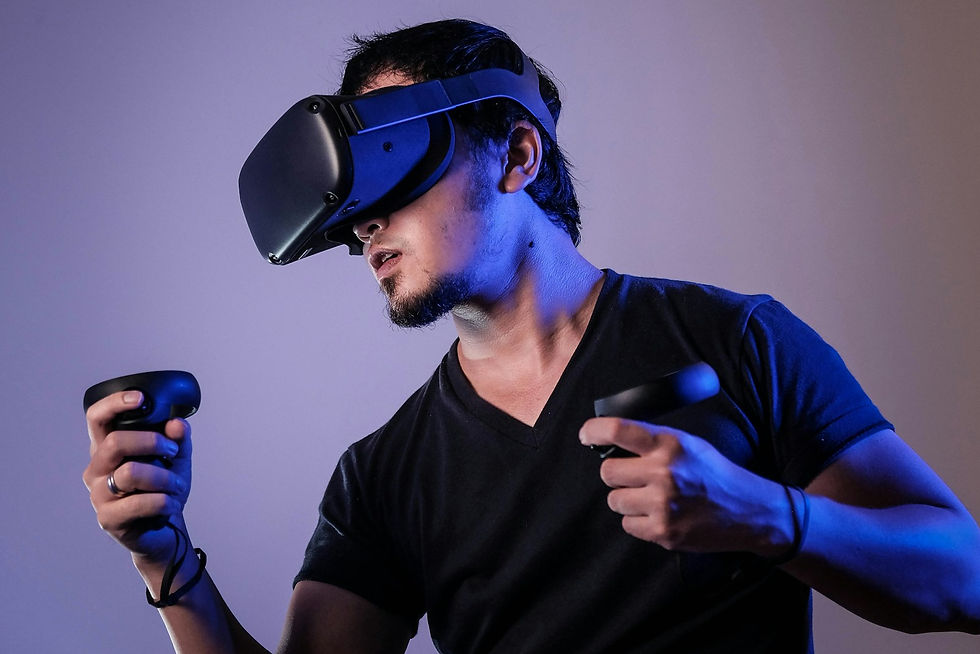
1. Clinical skills training. Learners can repeat assessments, equipment checks, handovers, and procedures until the sequence becomes familiar. Branching scenarios also show how one decision changes the next event.
2. Surgical planning and rehearsal. Spatial models help teams understand anatomy, discuss approaches, and rehearse complex steps before entering the operating room. This complements—not replaces—clinical judgment and established planning tools.
Explore the surgical planning and simulation capabilities when a procedure requires shared spatial understanding across a multidisciplinary team.
3. Emergency preparedness. Teams can rehearse rare, high-consequence events such as mass-casualty intake, resuscitation, evacuation, or sudden equipment failure without disrupting a live department.
4. Hospital onboarding and safety. New staff can learn layouts, isolation procedures, escalation paths, and local protocols before working independently. Consistent modules reduce variation between instructors and shifts.
See how hospital training and safety protocol solutions can turn written procedures into practice with realistic choices and consequences.
5. Patient education. Interactive anatomy, treatment journeys, and equipment demonstrations can make unfamiliar information more concrete. Experiences should be brief, accessible, and paired with a clinician who can answer questions.
Mimic Health XR develops patient education and engagement experiences that help people understand care pathways rather than simply watch them.
6. Rehabilitation and physical therapy. Guided movement tasks, progressive challenges, and immediate visual feedback can support motivation and repetition under professional supervision.
Review the rehabilitation and physical therapy applications for immersive exercises and patient-centered recovery programs.
7. Mental health and cognitive support. Carefully designed environments may support relaxation, graded exposure, attention exercises, or clinician-guided therapeutic activities. Screening, consent, supervision, and an easy exit are essential.
The mental health and cognitive support solutions show how immersive content can be designed around safety and therapeutic intent.
8. Remote consultation and collaboration. Shared spatial content can help specialists discuss anatomy, equipment, or treatment plans across locations, particularly when a flat video call cannot communicate depth.
Learn more about telehealth and remote consultation experiences that connect clinicians and patients through interactive digital environments.
9. Communication practice with virtual patients. Conversational characters can help clinicians rehearse history-taking, informed consent, de-escalation, and sensitive conversations. Scenarios can vary language, emotion, health literacy, and response to the learner’s choices.
How to Choose the Right First Project
A first project should be meaningful enough to matter and bounded enough to evaluate. Avoid beginning with an enterprise-wide promise. Choose one workflow, one audience, one setting, and one decision about what success looks like.
Good pilot candidates are repeated frequently, expensive or difficult to simulate physically, risky to practice on real patients, or dependent on spatial understanding. They should also have an identifiable owner who can recruit users and act on the results.
Write the use case as an outcome statement: “New emergency nurses will complete the isolation-room sequence with fewer missed steps,” or “Patients will explain the treatment pathway more accurately after the education session.” This is stronger than “We want a VR module.”
Before selecting a vendor, score the project against clinical relevance, user volume, content stability, hardware constraints, measurement feasibility, accessibility, and internal sponsorship. A technically impressive project with no operational owner usually stalls after the demo.
Designing Safe and Realistic Clinical Experiences

Clinical credibility begins with subject-matter experts. Involve clinicians, educators, safety leads, and representative users early. They should review objectives, terminology, equipment, decision points, consequences, and debriefing prompts.
Realism must serve learning or care—not decoration. Accurate timing, meaningful choices, believable behavior, and clear feedback matter more than filling every surface with visual detail. Users should understand what they are expected to do and why.
Build comfort and accessibility into the design. Offer seated modes when appropriate, readable text, subtitles, adjustable audio, simple controls, hygiene procedures, and a clear way to pause or exit. Screen users for motion sensitivity and relevant clinical contraindications.
For training, a structured debrief is often where experience becomes learning. Capture the learner’s actions, then help an instructor discuss reasoning, teamwork, priorities, and alternative choices without using the simulation as punitive surveillance.
Technology, Integration, and Data Requirements

Start with the operating environment. Decide whether the experience will run on standalone headsets, tethered workstations, tablets, or mixed-reality devices. Check room size, charging, storage, cleaning, network access, device management, and support ownership.
Then define the information flow. A training pilot may only need anonymized learner IDs and completion records. A clinical application may touch protected health information, scheduling, identity, or medical records and therefore require deeper privacy, security, and governance review.
Ask vendors how data are collected, encrypted, retained, exported, and deleted; where services are hosted; who can access administrative dashboards; how roles are managed; and what happens when a device is lost. Confirm whether offline operation is available for sensitive or unreliable environments.
Mimic Health XR combines the underlying XR, scanning, and motion-capture technology needed for spatial healthcare experiences, but each implementation should select only the components required by the outcome.
Interoperability should be proportional to the pilot. Avoid delaying a learning experiment with unnecessary enterprise integration, but do not ignore a required learning-management-system export or identity workflow. Document what is essential for launch and what can follow after evidence of value.
Measuring Outcomes and Return on Investment

Measurement should begin before content production. Capture a baseline using the same definitions you will use after launch. Measures may include completion time, missed critical steps, knowledge retention, confidence, patient comprehension, instructor hours, travel, equipment use, or time away from clinical duties.
Separate activity from outcome. Headset sessions and module completions show adoption, not effectiveness. Pair usage with a performance measure and, where possible, compare results with the current training or education method.
Calculate total cost across content design, clinical review, hardware, licenses, integration, device management, hygiene, training, support, updates, and replacement. Compare that with avoided lab time, reduced travel, instructor capacity, faster onboarding, fewer consumables, or improved throughput.
Use leading and lagging indicators. Early indicators—completion, usability, confidence, and errors inside the simulation—help teams improve quickly. Later indicators—retention, observed behavior, patient understanding, or savings—show whether value persists.
A Practical 90-Day Implementation Roadmap

Days 1–15: Define. Name the workflow, audience, owner, baseline, target outcome, and constraints. Interview users, map the current process, identify risks, and agree on the smallest credible scenario.
Days 16–35: Design. Write objectives, decisions, feedback, accessibility requirements, and data rules. Create a simple storyboard or prototype and review it with clinical experts and end users before building the full experience.
Days 36–60: Build and validate. Produce the scenario, test hardware and device management, complete security and safety reviews, and run structured usability sessions. Correct clinical inaccuracies and confusing interactions before broader access.
Days 61–75: Pilot. Train facilitators, recruit a representative cohort, record baseline and pilot measures, observe sessions, and capture qualitative feedback and performance data.
Days 76–90: Decide. Compare results with success criteria. Document what worked, what failed, cost per user, support demands, and required changes. Scale only if evidence supports it; otherwise refine the content or choose a better-fit use case.
Review Mimic Health XR’s healthcare applications to identify a focused starting point across training, patient engagement, rehabilitation, remote care, and visualization.
Frequently Asked Questions
What is virtual reality in healthcare?
It uses immersive computer-generated environments for healthcare training, planning, education, rehabilitation, therapy, collaboration, or patient engagement. The user interacts with spatial content instead of only viewing a flat screen.
How is VR different from AR in healthcare?
VR replaces visible surroundings with a digital environment. AR adds digital information to the real world. Mixed reality allows digital objects to remain spatially anchored and interactive within a physical environment.
What is the best first VR healthcare use case?
Choose a repeated, high-value workflow that is difficult, costly, risky, or disruptive to practice conventionally. Keep the audience and setting narrow, and define a measurable outcome before selecting technology.
Can VR replace clinical training with real patients?
No. VR adds safe repetition, standardized scenarios, and exposure to rare events, but should complement supervised clinical education, simulation, and real-world experience.
Is virtual reality safe for patients and staff?
It can be used safely with appropriate screening, hygiene, accessibility, session limits, supervision, content review, and a clear exit. Controls must match the user group and application.
What hardware does a hospital VR pilot need?
Many pilots use standalone headsets, secure storage, charging, cleanable interfaces, device management, and a suitable room. Higher-fidelity applications may need computers, tracking, haptics, or mixed-reality devices.
How should a healthcare organization measure VR success?
Measure a defined outcome such as fewer missed steps, faster completion, better retention, improved patient comprehension, reduced instructor time, or lower delivery cost. Usage alone is not proof of effectiveness.
How much does virtual reality in healthcare cost?
Cost depends on custom content, hardware, licenses, integrations, support, updates, and rollout size. Evaluate total cost of ownership against the current method and the value of the target outcome.
Does healthcare VR need EHR integration?
Not always. A training pilot may only need anonymized IDs or learning records. Clinical workflows involving patient data may require identity, scheduling, or EHR integration plus privacy and security review.
How long does a healthcare VR pilot take?
A tightly scoped pilot can often be designed, built, and evaluated in roughly 90 days, though complex validation, custom hardware, integrations, or governance may extend the schedule.
Conclusion: Build the Program Around the Outcome
Virtual reality in healthcare succeeds when it solves a specific human and operational problem. Begin with a workflow, design with clinical users, control safety and data risks, and measure an outcome that matters. The result is a program that can earn trust and scale—not a headset searching for a purpose.
Ready to turn a healthcare challenge into a practical XR experience? Talk with Mimic Health XR about a focused immersive healthcare pilot and define the first measurable use case.


Comments