.png)
.png)
Why Hospitals Are Rapidly Adopting AR in Healthcare for Accuracy and Efficiency?
Augmented Reality is no longer viewed as an experimental tool in healthcare. Hospitals across the world are integrating AR into clinical procedures, diagnostics, training, and patient care because it brings clarity, precision, and real-time understanding to environments where decisions truly matter. By placing useful digital information over the physical world, AR helps clinicians see deeper, act faster, and move more confidently through high-pressure workflows.
The result is measurable improvement in accuracy and operational efficiency. Doctors receive visual guidance at the point of care, nurses follow step-by-step workflows with fewer errors, and students interact with complex anatomical structures through hands-on spatial exploration. With the ongoing rise of AI-assisted overlays, digital twins, and advanced imaging, AR has become one of the most important technologies driving clinical transformation.
This article explores why hospitals are adopting AR so quickly and how it improves accuracy, speed, and decision-making across care areas.

AR Improves Clinical Accuracy Through Visual Overlays
The main reason hospitals are adopting AR is that it helps clinicians see what cannot be seen with the naked eye. AR systems project anatomical structures, tool paths, or procedural guidance directly onto the patient or clinical workspace.
Examples include:
vein visualization for vascular access
real-time anatomical mapping
surgical incision guidance
depth, angle, and orientation prompts
imaging overlays during minimally invasive procedures
These experiences are easier to understand when seen in practice, similar to the clinical benefits shown in augmented reality support systems in clinical environments.
When clinicians can follow overlays instead of relying only on memory or 2D screens, accuracy improves significantly.
AR Reduces Cognitive Load for Busy Clinicians
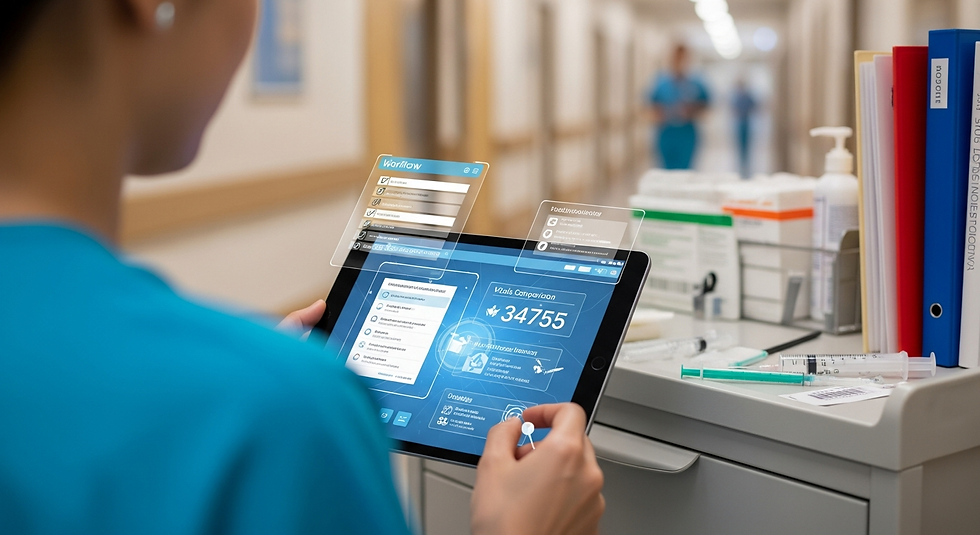
Hospitals are fast-moving environments where clinicians need instant access to reliable information. With AR, this information appears within their line of sight, reducing the need to turn to monitors, look up references, or switch between tools.
AR helps reduce cognitive effort by displaying:
vitals
instructions
imaging comparisons
dosage reminders
sterilization verification
patient charts anchored to the bedside
This allows clinicians to maintain focus during procedures and reduces error potential caused by distraction.
AR Supports Faster Decision Making
AR improves decision-making for surgeons, radiologists, emergency teams, and general clinicians by giving them real-time context inside the clinical environment.
Examples include:
visual alerts that highlight risks
step sequencing that ensures correct procedure order
anatomical overlays that match the patient’s structure
warnings when tools move near sensitive areas
This level of guidance shortens procedure times and strengthens safety.
Hospitals often integrate these capabilities into broader immersive systems similar to the tools found on the Mimic Health XR tech page.
AR Improves Training and Skill Development
AR supports both early medical education and professional development through dynamic, interactive training.
Students and clinicians can view:
3D anatomy in full scale
guided procedure steps
pathology demonstrations
spatial learning modules
AR-based OSCE practice stations
Unlike traditional models or textbooks, AR teaches through movement and real-world interaction. Training workflows like these align naturally with the immersive methods applied in XR workflows used across hospital operations.
This keeps education practical, scalable, and accessible.
AR Improves Efficiency on the Clinical Floor
Efficiency is crucial in hospital operations. AR improves efficiency through:
hands-free instructions
automated compliance reminders
clean workflow visualization
quicker onboarding for new staff
Reduced manual documentation
faster equipment identification
Nurses, technicians, and assistants benefit from AR-supported routines that show the correct steps without requiring verbal supervision.
AR Enhances Surgical Planning and Preparation
AR supports preoperative planning by displaying accurate, patient-specific visuals inside the operating space.
These visuals may include:
projected incision paths
3D holograms of tumor shapes
vessel route visualization
reconstructed anatomy from scans
AR is even more powerful when combined with patient-specific data models such as digital twin models, improving accuracy in treatment planning.
This combination prepares surgical teams more thoroughly before the first incision is made.

AR Strengthens Emergency Response Scenarios
Emergency rooms often require fast shared decision-making. AR can unify teams by delivering synchronized visual cues directly into the environment.
Triage information appears above the patients
Resuscitation instructions appear on the equipment
alerts appear in different colors for clarity
critical values appear without the monitor searching
This reduces response time, which directly impacts outcomes.
AR Improves Patient Understanding
Patients often struggle with complex medical explanations. AR makes counseling and education easier by offering visual clarity.
Patients can view:
3D models of conditions
treatment pathways
progress prediction
anatomical comparisons
rehab instructions
This improves trust, adherence, and confidence in care plans.
AR Reduces Errors Through Standardized Guidance
AR supports standardization across departments by guiding procedures the same way every time.
This includes:
catheter insertion
medication preparation
wound care
instrument placement
device setup
Consistency reduces variation and lowers risk.
Conclusion
Hospitals are adopting AR because it delivers clear improvements in accuracy, speed, and patient-centered care. Visual overlays help clinicians perform procedures more confidently, AR-supported workflows reduce cognitive load, and interactive training improves skill development. As AR integrates with digital twins, AI-driven guidance, and spatial data systems, it will continue becoming a central part of healthcare operations.
Mimic Health XR supports hospitals with immersive AR tools, real-time guidance systems, and simulation technology designed to improve performance across clinical teams.
FAQs
1. Why are hospitals adopting AR so quickly?
Because it improves clinical accuracy, reduces workload, and enhances patient care.
2. Can AR help during surgical procedures?
Yes, AR offers incision guidance, anatomy overlays, and real-time alerts.
3. Does AR reduce clinical errors?
AR provides step-by-step visual guidance that improves consistency and reduces mistakes.
4. How is AR used in training?
Students interact with anatomy, simulations, and guided procedures through immersive visuals.
5. Can AR help patients understand treatments?
Yes, AR offers 3D models and visual aids that make complex conditions easy to understand.
6. Is AR safe for clinical use?
When integrated correctly, AR enhances safety by strengthening awareness and reducing distraction.


Comments