.png)
.png)

XR Clinical Onboarding for Safer Healthcare Teams
- David Bennett
- 5 days ago
- 7 min read

How can hospitals onboard clinical teams faster without lowering safety, confidence, or protocol consistency?
Clinical onboarding is no longer just a paperwork process. New nurses, rotating clinicians, technicians, and support teams need to understand real workflows, patient safety expectations, equipment handling, escalation paths, and communication norms before they are placed under live pressure. That is why healthcare organizations are looking at XR clinical onboarding as a practical extension of simulation-based learning.
Mimic Health XR builds immersive systems for medical education and training, hospital training and safety protocols, AI avatars, 3D simulations, and remote consultation support. For onboarding leaders, the opportunity is simple: move essential practice out of static slide decks and into repeatable environments where staff can rehearse the work before it affects patients.
Table of Contents
Why Clinical Onboarding Needs Immersive Practice

Hospitals ask new staff to learn policies, equipment, team roles, digital systems, and unit culture at the same time. Even experienced clinicians can struggle when they join a new ward, specialty, country, or technology stack. Traditional onboarding often separates these topics into lectures, checklists, and occasional shadowing, which makes it hard to test readiness under realistic conditions.
XR changes the rhythm of onboarding because it gives staff an interactive place to practice. A learner can enter a virtual ward, respond to a deteriorating patient, identify missing protective equipment, communicate with a colleague, or review the steps of a device setup. The point is not to replace expert supervision. The point is to make supervised practice more consistent, visual, and repeatable.
For Mimic Health XR, this fits naturally into the wider applications of Health XR: visualizing complexity, strengthening communication, and helping teams make safer decisions before real-world pressure arrives. Onboarding becomes a structured pathway rather than a passive introduction.
New staff can repeat high-risk scenarios without disrupting live care.
Educators can standardize what every cohort sees, hears, and practices.
Managers can observe decision-making, not just completion of a checklist.
Teams can rehearse handoffs, escalation, and patient communication together.
Map Onboarding to Real Hospital Workflows
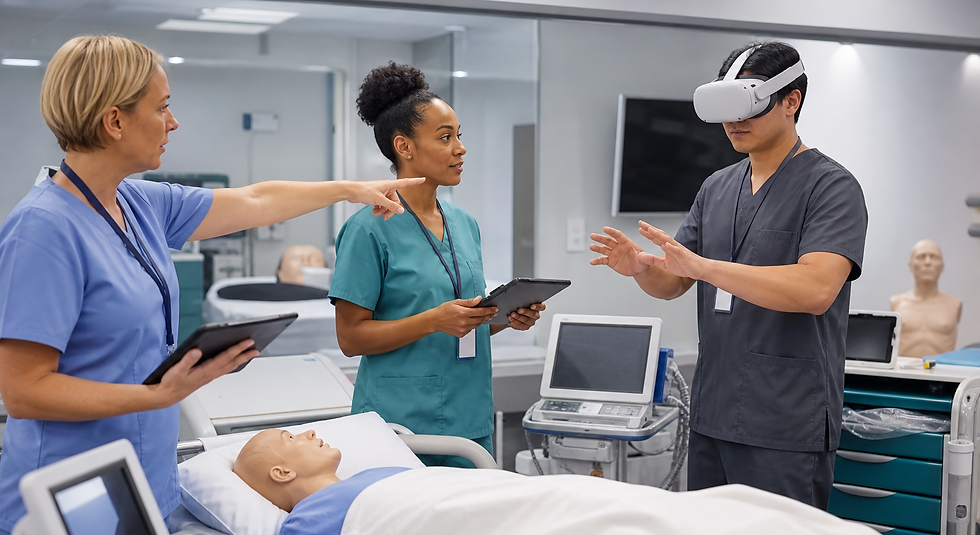
The strongest onboarding programs start with workflows, not technology. A hospital should first identify the moments where new team members are most likely to hesitate: patient intake, infection-control steps, medication checks, equipment setup, code response, telehealth triage, documentation handoff, or family communication.
Once those moments are mapped, 3D simulations can turn them into interactive modules. Instead of reading about a process, staff move through it. They see the room layout, follow the sequence of actions, and make decisions in context. This is especially useful for teams that must understand spatial relationships, equipment placement, and multidisciplinary coordination.
A useful onboarding curriculum usually mixes three kinds of modules. The first introduces the environment, such as a ward, training room, remote consultation flow, or device demonstration. The second gives staff repeatable practice with tasks and protocols. The third creates scenario pressure, where timing, communication, and prioritization matter.
That structure also helps onboarding scale. A hospital can reuse the same core experience for nurses, physicians, technicians, and administrative teams, then adjust prompts, avatar interactions, assessment criteria, and debrief questions for each role. The technology becomes a shared foundation, while the learning path remains specific.
This workflow-first approach also keeps XR projects grounded. Instead of building a visually impressive demo that sits outside day-to-day training, the hospital can connect each scenario to a named policy, a known competency, and a manager who owns the outcome. That makes the program easier to approve, easier to teach, and easier to measure after launch.
Use XR to Standardize Safety and Protocol Training

Safety training is one of the clearest use cases for XR onboarding. Mimic Health XR already supports hospital safety protocol simulations for emergency response, infection control, equipment handling, and repeatable preparedness drills. Onboarding can use the same logic to make safety culture visible from day one.
The most valuable safety modules are usually practical and scenario-based. A staff member may need to identify isolation-room steps, choose the correct PPE sequence, respond to an alarm, prepare a room for a procedure, or escalate a deteriorating patient to the right team. Each action can be timed, observed, repeated, and discussed during debrief.
This matters because safety is not only a memory test. It is a behavior pattern under pressure. Staff need to recognize cues, communicate clearly, and follow protocol even when the situation feels busy. XR can simulate that complexity without turning a live ward into a training site.
Emergency response simulations can test prioritization and team communication.
Infection-control modules can reinforce donning, doffing, isolation, and sterilization steps.
Equipment training can reduce first-use confusion before staff handle devices on the floor.
Virtual refreshers can support rotating staff, agency teams, and multilingual cohorts.
Bring AI Avatars Into Role-Based Coaching

AI avatars add a conversational layer to onboarding. Instead of asking learners to click through static prompts, a smart avatar can act as a patient, family member, virtual preceptor, interpreter, or team colleague. Mimic Health XR’s AI avatar work is especially useful where empathy, clarity, language, and repeated conversation practice matter.
Role-based coaching is powerful because onboarding needs differ by function. A nurse may practice patient intake and safety escalation. A physician may practice consent explanations or procedure planning. A technician may rehearse equipment setup. A front-desk team member may practice telehealth navigation or patient instructions.
The avatar can keep the experience consistent while still allowing variation. It can ask follow-up questions, simulate uncertainty, prompt learners to explain in plain language, or represent a patient with different levels of health literacy. That gives educators a repeatable way to train communication, not only technical steps.
For international teams, avatars can also support multilingual practice and culturally sensitive communication. A learner can rehearse how to explain an unfamiliar procedure, confirm understanding, or calm a worried patient without turning a real consultation into the first attempt. That kind of repetition is hard to schedule with live role play alone.
For patient-facing roles, avatar-led onboarding can connect directly to patient education and engagement. Staff learn how to explain complex care pathways with confidence before they have to guide a real patient through a diagnosis, rehabilitation plan, or remote-care workflow.
Measure Competency Before Staff Reach the Floor

The biggest advantage of digital onboarding is that practice can produce measurable evidence. Completion alone does not prove readiness. A staff member may finish a module while still missing key steps, hesitating during escalation, or using unclear communication during handoff. XR can capture the behaviors that matter.
Useful metrics include decision time, sequence accuracy, missed safety steps, repeated attempts, confidence ratings, and instructor observations. These measurements should not be used as a blunt surveillance tool. They should guide coaching, remediation, curriculum design, and manager confidence before staff move into live settings.
Competency validation also helps teams find systemic gaps. If many learners miss the same PPE step, the onboarding material may need revision. If staff from different units handle the same emergency scenario differently, leaders may need a clearer standard. If remote-care teams struggle with digital navigation, the process itself may need simplification.
That is where XR links onboarding to operational improvement. It supports training, but it also gives administrators better insight into how protocols are understood across departments, campuses, and hybrid care models such as telehealth and remote consultation support.
Build a Scalable XR Onboarding Program

A scalable XR onboarding program does not need to begin with every possible scenario. The best first step is a focused pilot tied to a clear operational pain point. For one hospital, that may be infection control. For another, it may be onboarding new nurses to emergency response workflows. For a medtech team, it may be device training before product rollout.
A practical rollout can begin with five decisions: choose the audience, define the workflows, select the safety or competency outcomes, decide how instructors will debrief performance, and identify the internal links to existing training policies. Once the pilot works, the same framework can expand into more departments and use cases.
Mimic Health XR’s mix of VR, AR, MR, 3D scanning, motion capture, AI avatars, and digital human systems makes this expansion realistic. A hospital can start with one immersive module, then add role-based avatar coaching, 3D anatomy visualization, procedure rehearsal, equipment familiarization, or remote-care navigation as the program matures.
The result is a more active onboarding culture. Staff are not simply told what the organization expects. They see it, practice it, make decisions inside it, receive feedback, and return to practice when they need a refresher. That is the difference between orientation as information and onboarding as readiness.
For leadership teams, the same model can support continuing education after onboarding ends. When protocols change, equipment is introduced, or a department prepares for a new service line, the XR module can become a refresher pathway. That turns the initial onboarding investment into a reusable training asset for long-term operational resilience.
FAQ
What is XR clinical onboarding?
XR clinical onboarding uses virtual, augmented, or mixed reality to help healthcare staff practice workflows, protocols, communication, and equipment use before they perform those tasks in live care environments.
How is XR onboarding different from standard simulation training?
Traditional simulation often depends on physical labs, mannequins, or scheduled drills. XR can add repeatable digital environments, role-based scenarios, AI avatar interactions, and measurable practice that can scale across sites and cohorts.
Which healthcare roles can use XR onboarding?
Nurses, physicians, technicians, therapists, patient support teams, telehealth coordinators, educators, and administrative staff can all use XR onboarding when the scenario is matched to their real responsibilities.
Can XR help with hospital safety protocols?
Yes. XR is especially useful for infection control, emergency response, PPE practice, equipment familiarization, escalation pathways, handoffs, and other safety behaviors that require practice under realistic conditions.
Do hospitals need to replace existing training systems?
No. XR onboarding works best as an extension of existing education, compliance, and simulation programs. It gives teams a more immersive practice layer while preserving expert instruction and local policy.
How can AI avatars support onboarding?
AI avatars can simulate patients, family members, colleagues, interpreters, or virtual coaches. They help staff rehearse communication, empathy, instructions, and role-specific decision-making in a repeatable format.
What should a hospital measure in XR onboarding?
Hospitals can measure task accuracy, decision time, missed steps, repeated attempts, communication choices, scenario completion, and instructor feedback. The goal is better coaching and safer readiness, not box-checking.
What is the best first XR onboarding pilot?
The best pilot is a focused, high-value workflow such as infection control, emergency response, new equipment training, or telehealth navigation. A narrow pilot makes it easier to prove value and expand responsibly.
Conclusion
XR clinical onboarding gives healthcare teams a safer way to practice the moments that matter before they reach patients. It turns orientation into active rehearsal, supports role-based coaching, and gives educators clearer evidence of readiness.
Mimic Health XR helps hospitals, educators, and healthcare innovators build immersive onboarding, training, AI avatar, and 3D simulation experiences. Explore Mimic Health XR’s applications or contact the team to discuss a tailored onboarding program.


Comments