.png)
.png)
XR Emergency Preparedness Training for Healthcare Teams
- David Bennett
- 2 days ago
- 7 min read

How can hospitals prepare entire teams for rare, high-consequence emergencies without disrupting patient care?
XR emergency preparedness training gives hospitals a repeatable way to rehearse mass-casualty triage, surge workflows, incident command, ambulance handoffs, and team communication in a controlled immersive environment. Instead of asking staff to imagine the pressure of a rapidly changing event, extended reality lets them experience decisions, interruptions, competing priorities, and resource constraints together.
The goal is not spectacle. The value comes from realistic practice that connects clinical judgment with operational coordination. When scenarios are designed around local protocols and followed by structured debriefing, teams can expose weak handoffs, improve shared mental models, and build confidence before a real emergency tests the system.
Table of Contents
What Is XR Emergency Preparedness Training?

XR emergency preparedness training uses virtual reality, augmented reality, mixed reality, spatial simulation, and responsive digital patients to reproduce urgent healthcare events. Learners can enter a simulated emergency department, ambulance bay, treatment zone, or command center and respond as the situation evolves. The environment may introduce new patients, changing vital signs, limited beds, delayed supplies, communication failures, or sudden changes in hazard conditions.
Unlike a single-user technical simulator, emergency preparedness is a system exercise. Doctors, nurses, paramedics, bed managers, infection-control teams, security staff, and operational leaders must coordinate their actions. That systems focus connects naturally with XR clinical onboarding and hospital safety training, because emergency readiness depends on familiar workflows long before a crisis begins.
Immersive drills can be delivered in a dedicated simulation center, a repurposed training room, or distributed locations connected to the same scenario. The format makes it easier to repeat the same event for different shifts, compare performance across cohorts, and adjust complexity without rebuilding a physical disaster scene. It also allows facilitators to pause, rewind, or replay critical moments during debriefing.
A strong program is designed around a clear operational question: Can the team recognize the event, establish leadership, sort patients, communicate capacity, move people safely, and escalate at the right time? Technology supports that question; it does not replace clinical policy, qualified facilitators, or hands-on equipment practice.
Repeat rare events without exposing real patients to risk.
Standardize scenarios across departments, shifts, and locations.
Practice decisions and communication under realistic time pressure.
Capture observable actions for a structured after-action review.
Designing Mass-Casualty Triage Scenarios That Build Readiness
Mass-casualty triage is difficult because clinicians must act with incomplete information while the number of patients may exceed immediately available resources. An effective XR scenario therefore tests more than diagnostic recall. It asks learners to scan the scene, apply the organization’s triage method, identify immediate threats, assign treatment priorities, and revise decisions when a patient’s condition changes.
Scenario designers should begin with learning objectives, not visual effects. One exercise may focus on initial sorting and rapid reassessment. Another may test pediatric considerations, decontamination boundaries, behavioral responses, language barriers, family reunification, or the movement of patients into definitive care. The virtual patient population should be clinically plausible, diverse, and calibrated to the experience level of the team.
This approach extends the repeatability of VR training for nurses and the risk-free rehearsal used in VR surgery training. The difference is scale: emergency preparedness evaluates how individual decisions interact across a crowded, fast-moving care pathway.
Useful pressure comes from meaningful tradeoffs. If every bed, clinician, and supply is available, the drill cannot reveal how teams prioritize. Facilitators can introduce a delayed imaging resource, a blocked corridor, a deteriorating patient, or conflicting radio information. Each inject should connect to an objective and be discussed afterward; random chaos creates stress but does not necessarily create learning.
Accessibility and psychological safety also matter. Participants need orientation to the equipment, a way to report discomfort, and permission to pause. Scenarios should avoid unnecessary graphic content. The most credible training often relies on sound, timing, spatial density, team interactions, and changing clinical information rather than shock imagery.
Training Incident Command and Cross-Team Coordination
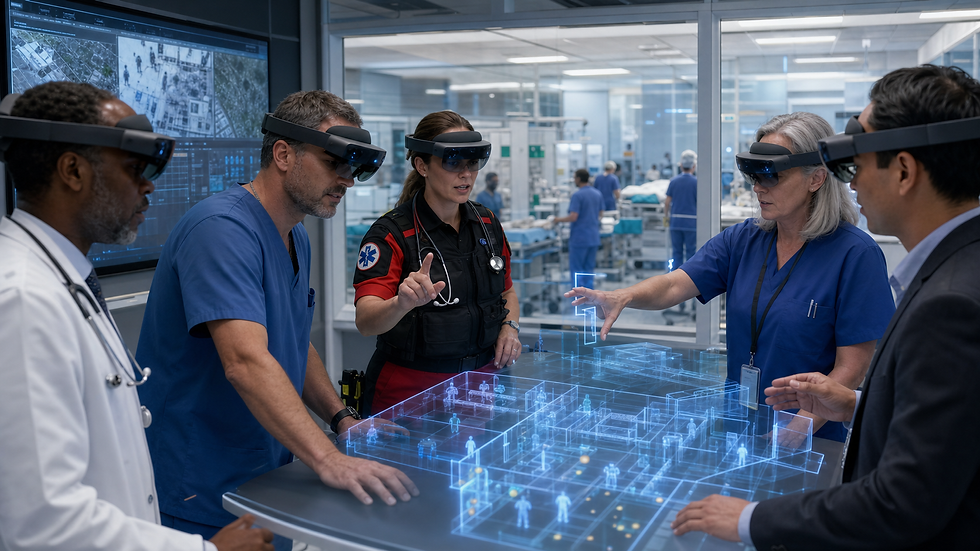
Clinical triage is only one layer of emergency response. A hospital also needs clear command roles, reliable escalation, capacity awareness, resource allocation, staff recall, internal communications, and coordination with external agencies. XR can place command participants inside a shared operational picture while frontline teams work through the same evolving scenario.
Leaders can rehearse when to activate an incident structure, how to communicate objectives, who owns specific decisions, and how information moves between the emergency department, operating rooms, critical care, laboratories, security, facilities, and executive leadership. These exercises reveal where a plan is technically complete but difficult to execute under pressure.
Spatial representations can also connect emergency readiness with hospital design and workflow simulation and clinical digital twins. A team can test whether routes conflict, whether temporary zones have enough space, where bottlenecks appear, and how a surge plan changes patient flow before modifying a real facility.
The scenario should include communication friction that mirrors the real system: a delayed update, a handoff between channels, an unclear request, or two teams using different terminology. Facilitators then observe whether participants confirm critical information, state priorities clearly, close the communication loop, and maintain a shared view of capacity and risk.
For multi-site health systems, connected XR sessions can help local teams practice within a common framework while retaining site-specific roles. This supports consistency without pretending every hospital has the same layout, staffing, escalation policy, or community risk profile.
Connecting Pre-Hospital Handoffs to Emergency Workflows

Emergency performance often depends on transitions: scene to ambulance, ambulance to triage, triage to treatment, and treatment to surgery or critical care. These moments are vulnerable because responsibility, information, equipment, and physical space change at the same time. XR makes the transition visible and repeatable rather than treating it as a sentence in a policy document.
A connected drill can begin with pre-hospital responders assessing the simulated event, continue through transport communication, and end with an ambulance-bay handoff. The receiving team can practice preparing the right zone, confirming essential information, transferring monitoring safely, and reassessing rather than accepting the previous priority without question.
Conversational virtual patients and family members can add communication practice. They may provide incomplete histories, ask urgent questions, speak another language, or become distressed as conditions change. This capability builds on the patient-facing patterns described in AI avatars for healthcare engagement and immersive patient education, while keeping clinicians responsible for judgment and escalation.
Designers should preserve operational realism. A handoff exercise needs the language, equipment, spaces, and documentation habits the team actually uses. If the virtual workflow is disconnected from practice, participants may learn to succeed in the simulation rather than improve the real pathway.
The best cross-boundary drills include observers from both sides. Paramedics can explain why certain information was available or missing, while hospital teams can describe what they needed to prepare safely. That shared debrief turns a transfer problem into a joint improvement opportunity.
Measuring Performance and Improving Every Drill

A drill becomes valuable when observation leads to improvement. XR platforms can capture timestamps, route choices, triage changes, communication events, task completion, and scenario outcomes. These records help facilitators reconstruct what happened, but metrics must be interpreted in context. Faster is not automatically safer, and a numerical score cannot explain why a team hesitated.
Begin with a small set of measures tied to the exercise objectives. Examples include time to recognize the event, time to establish command, accuracy and consistency of triage decisions, frequency of reassessment, completion of closed-loop communication, time to activate surge areas, patient movement delays, and the team’s ability to identify emerging safety threats.
Organizations exploring predictive analytics in healthcare XR can use repeated scenario data to find recurring bottlenecks and target future drills. Analytics should support human review, not turn an exercise into opaque automated grading. Participants need to understand what was measured, how data will be used, and who can access it.
A structured debrief typically moves from reactions to reconstruction, analysis, and action. What did the team notice? What did they expect? Where did the shared picture diverge? Which choices were shaped by the scenario, and which reflect a real workflow gap? The final output should be a short improvement plan with named owners, realistic deadlines, and a decision about what to retest.
Readiness grows through a cycle: assess risk, design the scenario, orient participants, run the exercise, debrief, improve the system, and repeat. A staged rollout can start with one department and a focused triage objective, then expand into multidisciplinary surge and command exercises as facilitators gain experience.
Use objective-linked measures instead of a single composite score.
Separate individual skill gaps from workflow and system constraints.
Protect participant data and explain the purpose of recording.
Retest high-priority changes in the next scenario cycle.
Frequently Asked Questions
What is XR emergency preparedness training?
It is immersive, scenario-based practice that uses virtual, augmented, or mixed reality to help healthcare teams rehearse emergency decisions, communication, triage, patient flow, and incident coordination.
How does XR support mass-casualty triage training?
XR can present multiple evolving virtual patients, limited resources, time pressure, and changing conditions so teams can practice initial sorting, reassessment, escalation, and communication without putting real patients at risk.
Can XR replace full-scale hospital disaster drills?
No. XR is best used as part of a blended preparedness program. It can increase repetition and accessibility, while physical drills remain important for testing real equipment, spaces, transport, and interagency logistics.
Which healthcare roles should participate?
Depending on the objective, participants may include emergency clinicians, nurses, paramedics, incident commanders, bed managers, operating-room and critical-care teams, infection control, security, facilities, communications, and executives.
What should hospitals measure during an XR drill?
Measures should match the objectives and may include recognition time, command activation, triage consistency, reassessment, closed-loop communication, surge-zone activation, handoff quality, and observed patient-flow delays.
How realistic should virtual patients be?
They should be clinically plausible and responsive enough to support the learning objective. Realism should serve decision-making and communication, not rely on unnecessary graphic detail or visual complexity.
How often should emergency XR scenarios be repeated?
Frequency depends on risk, staff turnover, regulatory needs, and the objective. Short focused sessions can occur more often, while larger multidisciplinary exercises can be scheduled around improvement cycles and organizational priorities.
How can a hospital start an XR preparedness program?
Start with one high-priority workflow, define observable objectives, involve clinical and operational stakeholders, orient participants, run a small pilot, conduct a structured debrief, and expand only after addressing the lessons learned.
Conclusion
XR emergency preparedness training helps healthcare organizations turn plans into practiced team behavior. Its greatest strength is not the headset itself, but the ability to repeat complex events, connect clinical and operational roles, observe decisions, and improve the system before a real emergency demands flawless coordination.
Ready to design a healthcare XR scenario around your emergency workflows? Explore Mimic Health XR and discuss an immersive training program built around your teams, spaces, risks, and measurable readiness goals.


Comments