.png)
.png)
How Much Does VR Healthcare Training Cost in 2026?
- David Bennett
- Aug 14
- 9 min read

How much should a hospital, medical school, or healthcare organization budget for VR training?
There is no single price for virtual reality medical training because a short off-the-shelf module and a clinically validated, multi-user simulation are different products. A useful budget separates hardware, scenario design, software, 3D assets, integrations, facilitation, support, and evaluation instead of asking for one unexplained total.
This guide gives procurement, learning, simulation, and clinical leaders a practical framework for estimating cost, comparing delivery models, controlling scope, and calculating value. It also explains which questions to answer before requesting a proposal, so quotes are easier to compare and less likely to hide important implementation work.
Table of Contents
How Much Does VR Healthcare Training Cost?

The honest answer is that VR healthcare training is scope-priced. A focused pilot using existing hardware and one proven learning scenario may sit in a very different budget category from a custom program that recreates a hospital environment, includes responsive virtual patients, connects to a learning platform, supports multiple languages, and measures team performance across sites.
For early planning, think in three levels rather than searching for a universal price. A small pilot is designed to validate usability and learning fit with a limited cohort. A departmental program adds repeatable deployment, facilitator tools, reporting, and several scenarios. An enterprise program may include custom environments, multi-user workflows, integrations, governance, localization, device management, and ongoing content updates.
The cheapest quote is not always the lowest-cost program. If it excludes clinical review, deployment support, accessibility testing, or measurement, the organization may pay for those gaps later. The strongest first question is therefore not “What does a headset cost?” but “What behavior or workflow must improve, for whom, and how will we know?”
Organizations exploring medical education and training solutions should ask vendors to itemize assumptions. This turns an opaque number into a decision: what is reusable, what is custom, what is optional, and what will recur each year?
Pilot: prove learner acceptance, operational fit, and one priority outcome.
Departmental rollout: standardize several scenarios for a defined workforce.
Enterprise rollout: support multiple roles, locations, integrations, languages, and governance requirements.
What Is Included in a VR Healthcare Training Budget?

A complete budget normally has more components than the headset and application license. Hardware can include headsets, controllers, hygiene accessories, charging, storage, replacement units, computers, networking, and mobile device management. The correct setup depends on whether sessions are individual, instructor-led, multi-user, room-scale, or distributed across locations.
Content work often represents the larger strategic investment. It can include instructional design, clinical subject-matter review, scenario branching, dialogue, assessment logic, 3D environment creation, virtual patients, animation, voice recording, accessibility, testing, and updates. A detailed surgical or emergency workflow generally requires more validation than a simple orientation experience.
Implementation also matters. Budget for facilitator onboarding, learner orientation, scheduling, sanitation processes, technical support, analytics, data protection review, and evaluation. If a program needs single sign-on or learning-management-system reporting, define that integration before contracting rather than treating it as a late add-on.
Mimic Health XR combines immersive work with 3D simulation capabilities, AI avatars, and healthcare workflow design. Those layers can be selected according to the learning objective; they should not be added simply because the technology supports them.
One-time costs: discovery, design, clinical validation, 3D production, configuration, and initial deployment.
Recurring costs: licenses, hosting, support, device management, analytics, content maintenance, and facilitator refreshers.
Internal costs: staff time, procurement, IT/security review, space, scheduling, evaluation, and change management.
Which Factors Change the Price Most?

Scenario complexity is usually the biggest price driver. A linear orientation with a few interactions is simpler than a branching scenario in which a virtual patient responds to spoken questions, vital signs change, teammates take different roles, and assessment logic records decisions. More pathways mean more writing, production, testing, and clinical review.
Visual fidelity influences cost, but fidelity should match the task. Anatomical teaching, device handling, and spatial procedures may require precise 3D assets. Communication training may gain more from credible dialogue, emotion, and consequence than from photorealistic surfaces. A lower-cost visual treatment can still be effective when it preserves the cues learners need.
Customization is another major variable. Reusing a configurable platform, existing environment, or established interaction system is typically more efficient than building every component from zero. By contrast, recreating a specific ward, instrument, device, or protocol adds discovery, modeling, review, and approval cycles.
Other drivers include the number of roles, simultaneous users, supported devices, languages, accessibility requirements, offline use, security constraints, reporting depth, integrations, and expected content lifespan. For high-risk topics such as hospital training and safety protocols or surgical planning and simulation, clinical governance should be planned as core scope, not optional polish.
Pilot, Platform, or Custom Simulation: Which Model Fits?

A pilot is appropriate when the organization still needs evidence about comfort, workflow fit, learner acceptance, facilitator capacity, or technical deployment. Keep the pilot narrow: one audience, one scenario, a defined device setup, a short measurement plan, and a decision date. A pilot that tries to prove everything becomes an expensive miniature enterprise rollout.
A configurable platform is useful when common training patterns already exist and speed matters. The organization may license scenarios, customize branding or selected content, and use standard analytics. This model can reduce production cost, but buyers should confirm what can actually be changed, how data is handled, and whether the learning experience maps to local protocols.
A custom simulation is justified when the workflow, environment, device, patient population, or decision logic is distinctive and strategically important. Examples include a specialized procedure, a facility-specific safety pathway, a branded MedTech product, or a multi-role crisis scenario. Custom does not have to mean building an entire technology stack; experienced teams reuse stable foundations while tailoring the clinical content.
The right model may be blended. An organization could start with reusable training infrastructure, customize one high-value workflow, and add scenarios after evidence and facilitator capacity grow. This staged approach fits the implementation principles in the virtual reality in healthcare implementation guide and avoids committing to scale before operational readiness is known.
How to Control Cost Without Cutting Clinical Quality

Cost control starts with a measurable learning objective. “Create an impressive hospital metaverse” is hard to scope and easy to overbuild. “Help newly hired nurses recognize three deterioration cues and escalate using the local protocol” gives designers a boundary. Every scene, interaction, and data point can then be tested against that goal.
Reuse lowers cost when it is deliberate. Reusable environments, avatar systems, interaction patterns, dashboards, and device-management processes can support multiple scenarios. The organization should own a content roadmap so the first project creates foundations for the next one instead of a disconnected demonstration.
Use a phased review process. Approve the learning blueprint before detailed production; review a low-fidelity prototype before final art; validate clinical logic before recording all dialogue; and test on target hardware early. Decisions are cheaper to change at the blueprint stage than after animation, code, audio, and localization are complete.
Blend VR with other methods. Immersive practice is especially useful for spatial decisions, communication under pressure, rare events, and repeatable rehearsal. Reading, video, instructor discussion, mannequins, supervised clinical practice, and debriefing still have important roles. For example, VR training for nurses can combine individual rehearsal with facilitated reflection and hands-on skills practice.
Define one outcome and one priority audience for the first release.
Reuse stable technical foundations while customizing clinically important content.
Freeze decisions in stages and test on real target devices early.
Plan facilitator workflow, support, and evaluation at the same time as content.
Design the first scenario as part of a roadmap, not as an isolated demo.
How to Calculate the ROI of VR Medical Training
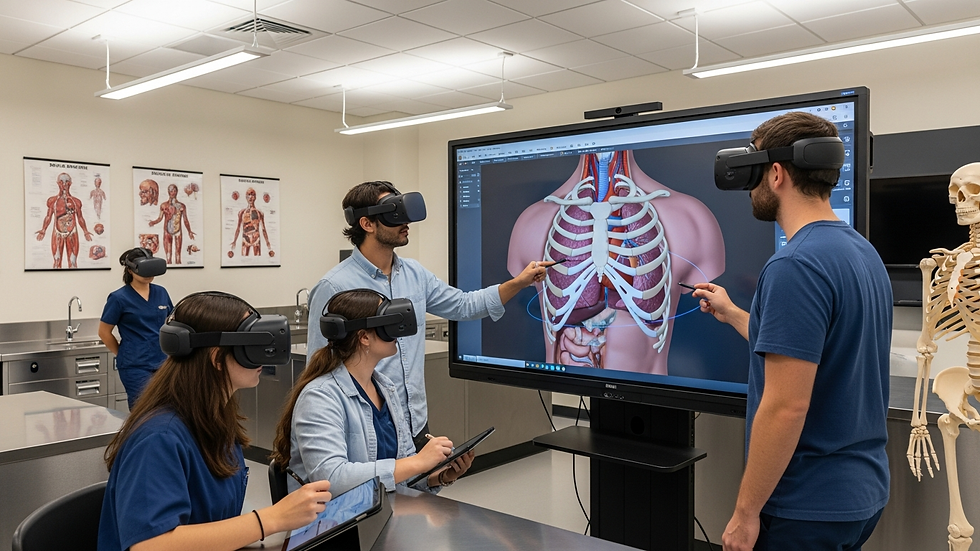
ROI should connect training activity to an operational or educational problem. Begin with the current baseline: instructor hours, simulation-center capacity, travel, equipment consumption, actor costs, learner release time, onboarding duration, failed competency checks, repeat training, or avoidable workflow variation. Then identify which costs or outcomes VR can realistically influence.
A simple total-cost view includes content and implementation, hardware, licenses, support, internal staff time, and expected updates across the useful life of the program. Divide that total by completed learners or successful practice sessions only after accounting for device utilization. A headset sitting unused is inexpensive hardware but poor investment.
Value can include more training opportunities, consistent scenarios across sites, access to rare events, faster readiness, stronger retention, reduced instructor setup, and better observation of decisions. Not every benefit should be converted into an exaggerated financial claim. Keep educational, operational, safety, and workforce measures visible as separate evidence.
Measurement should combine platform data with human evaluation. Completion time and choices can show what happened, while debriefs, competency checks, transfer observations, and follow-up assessments explain whether performance improved. For advanced programs, predictive analytics in healthcare XR can help reveal repeated workflow patterns, provided governance and interpretation remain clear.
Adoption: eligible learners, starts, completions, repeat sessions, and facilitator usage.
Learning: knowledge, decision quality, procedural sequence, communication, and retention.
Operations: instructor time, setup time, throughput, travel, scheduling, and device utilization.
Transfer: observed workplace behavior, escalation quality, workflow adherence, and selected safety indicators.
What Should You Put in a Vendor Brief?

A useful vendor brief makes quotations comparable. State the audience, learner numbers, locations, languages, target devices, delivery format, and desired launch window. Describe the real workflow and the decisions learners must practice. Include existing materials such as protocols, floor plans, device files, videos, assessment rubrics, and brand requirements when they are available.
Specify the evidence and governance requirements. Who provides clinical approval? Does the scenario need version control when a protocol changes? Which learner data may be collected? Where will it be stored? Who can see results? Are accessibility, infection control, offline delivery, or regulated-device constraints relevant?
Ask each vendor to separate discovery, content, software, hardware, integrations, deployment, training, support, and optional enhancements. Request assumptions, exclusions, review rounds, ownership terms, update pricing, and the criteria for accepting each milestone. A detailed proposal should explain not only what will be built but how it will be validated and operated.
For a tailored starting point, review the full range of Mimic Health XR applications and the underlying technology capabilities. A short discovery phase can then translate the clinical need into a scenario roadmap, delivery model, and evidence plan before major production begins.
Frequently Asked Questions
How much does VR healthcare training cost?
There is no universal price. Cost depends on whether the program uses existing content or custom scenarios, the number of learners and sites, hardware, clinical complexity, integrations, languages, analytics, support, and the level of validation required.
Is custom VR medical training more expensive than licensing a platform?
Usually, because custom work adds discovery, instructional design, 3D production, clinical review, testing, and project-specific logic. A hybrid approach can reuse a proven platform while customizing the workflows that matter most.
What is the biggest cost driver in a medical VR project?
Scenario complexity is often the biggest driver. Branching decisions, responsive virtual patients, multi-user roles, precise anatomy or equipment, voice interaction, and deep assessment all increase design, production, and validation effort.
Do hospitals need to buy high-end VR headsets?
Not always. Hardware should match the learning task, deployment environment, hygiene process, security requirements, and support capacity. A pilot should test the intended device before a large purchase.
Can VR training reduce healthcare training costs?
It can reduce selected costs such as repeated physical setup, travel, consumables, and instructor time while expanding access to standardized practice. Savings depend on utilization, rollout quality, and whether the scenario replaces or complements existing activities.
How many VR headsets does a healthcare organization need?
The answer depends on cohort size, session length, scheduling, cleaning and charging time, simultaneous-use requirements, and the number of locations. Model learner throughput before choosing a device quantity.
How long does a custom VR healthcare scenario take to develop?
Timing varies with content readiness, complexity, review availability, asset creation, integrations, testing, and procurement. A focused pilot can move faster than a multi-role, multilingual enterprise simulation. Approving a blueprint before full production reduces delays.
What should be measured in a VR medical training pilot?
Measure usability, comfort, completion, decision quality, learning improvement, facilitator workload, technical reliability, device utilization, and evidence of transfer appropriate to the objective. Set success criteria before the pilot starts.
Does VR replace mannequins, instructors, or clinical practice?
No. VR is strongest as part of blended learning. It adds repeatable immersive rehearsal, but hands-on equipment use, expert facilitation, debriefing, supervised practice, and real clinical experience remain essential.
How can we get an accurate VR healthcare training quote?
Provide a concise brief covering the audience, workflow, objectives, learner volume, locations, hardware, integrations, languages, clinical review, data requirements, timeline, and desired evidence. Ask for itemized assumptions and recurring costs.
Conclusion
The cost of virtual reality medical training becomes easier to understand when the organization defines the outcome first and separates content, technology, implementation, and ongoing operation. A disciplined pilot can test value without overcommitting, while a reusable roadmap can turn successful scenarios into a scalable training program.
Ready to scope a realistic budget and implementation plan? Contact Mimic Health XR to discuss your learners, clinical workflow, delivery environment, and the evidence your organization needs before investing.


Comments