
← All insights

Healthcare journal

How an AI Health Assistant Reduces Clinician Workload in Hospitals?

Concept illustration: How an AI Health Assistant Reduces Clinician Workload in Hospitals

For hospital managers evaluating an AI health assistant, the useful question is which administrative tasks consume staff time and whether an assistant changes that workload. This article focuses on patient communication, documentation and coordination, with a practical approach to measuring staff effort rather than assuming that automation saves time.

Build a workload measurement sheet

Choose one task, such as answering appointment preparation questions, and record its current volume, handling time and escalation rate. Include time spent correcting answers, checking drafts and helping people who cannot use the assistant. Assign a staff owner to decide which cases remain with the existing service.

Compare the pilot with a similar period and case mix. Report total staff minutes per completed task alongside rework and unresolved requests. A faster first response is not enough if follow-up work increases. Decide in advance what result would justify expansion and what would trigger a pause.

How do AI health assistants reduce workload in daily hospital operations?


Hospitals experience thousands of repeated tasks each day. AI assistants automate many of these tasks and present clinicians with only the information that truly requires their expertise.


AI systems can support:

  • symptom intake

  • scheduling

  • medication reminders

  • discharge preparation

  • follow up management

  • progress check ins

  • repetitive patient instructions


By reducing manual load, clinicians regain time for direct patient care.


Automating patient communication


Hospitals handle a constant flow of patient questions. AI health assistants manage many of these safely.
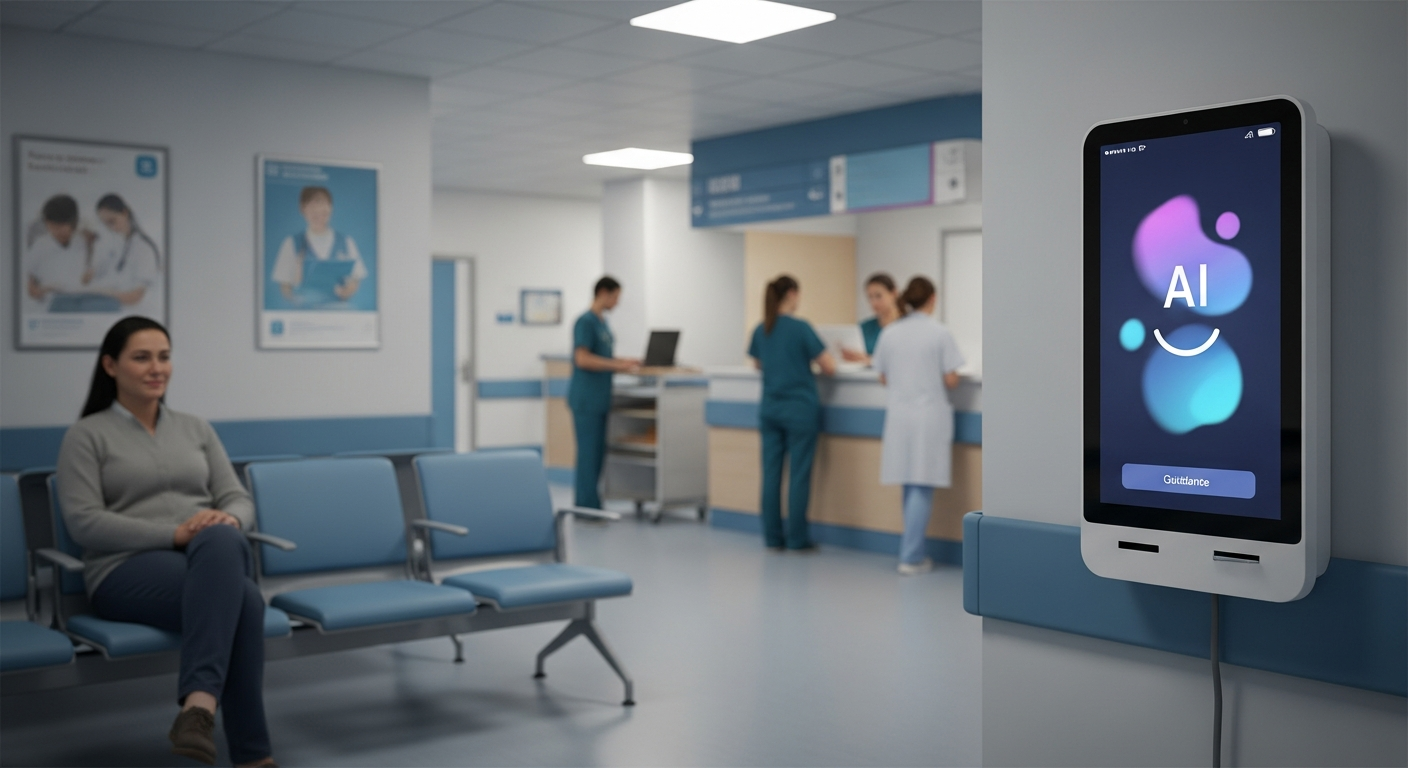

A patient using a realistic AI kiosk that automates routine communication in a hospital waiting area.

Examples include:

  • pre visit preparation requirements

  • insurance or billing questions

  • appointment confirmations

  • post procedure instructions

  • medication timing reminders


AI assistants provide consistent answers and escalate only the complex cases that need human review.


This automation supports clinical teams in the same way immersive workflows help streamline daily tasks inside Mimic Health XR technology systems.


Reducing documentation and data entry burden


Documentation is one of the heaviest burdens for clinicians. AI health assistants reduce it by:

  • auto populating fields

  • summarizing conversations

  • generating structured notes

  • transcribing clinician speech

  • updating medical records after verification


This reduces burnout and keeps documentation accurate without increasing time pressure.


Supporting staff coordination and workflow clarity


Hospitals rely on coordination between departments, and health assistants unify workflow information and ensure tasks are visible and well-organized.


They help by:

  • notifying nurses of updated orders

  • alerting teams to patient status changes

  • coordinating discharge readiness

  • reminding clinicians about pending tasks

  • reducing duplicate communication


These benefits align with the efficiencies created inside Transforming Healthcare with Virtual and Mixed Reality, where clarity and communication support smoother hospital operations.


A patient using a realistic AI kiosk that automates routine communication in a hospital waiting area.

How does AI improve patient navigation and education?


Patients often struggle with instructions, especially during stressful situations. AI assistants help guide them through:


  • wayfinding inside hospitals

  • preparation for tests or procedures

  • medication schedules

  • recovery exercises

  • chronic care management


AI health assistants explain information in clear, simple language. Patients feel more confident and less overwhelmed.


A realistic scene of an AI health assistant easing clinician workload at a busy hospital nurse station.

Benefits for hospital efficiency


AI health assistants deliver improvements across multiple hospital metrics.


Key benefits include:

  • reduced clinician burnout

  • faster patient movement through departments

  • fewer delays due to miscommunication

  • higher patient satisfaction

  • better compliance with care instructions

  • improved documentation accuracy

  • cost savings through automation


Hospitals adopting AI assistants achieve more predictable daily operations.


Challenges and considerations


Hospitals must implement AI responsibly. Key challenges include:

  • maintaining patient data privacy

  • avoiding over-reliance on automation

  • ensuring accurate model behavior

  • training staff to work alongside AI

  • verifying outputs before integrating into workflows


When designed well, AI assistants amplify human performance without replacing it.


A realistic scene of an AI health assistant easing clinician workload at a busy hospital nurse station.

Related reading

Back to insights