Mimic Health XR journal
Augmented reality
Explore augmented reality in healthcare education and communication. AR adds digital information to a view of the physical environment; the experience may use a handheld screen or a headset. The articles below consider how that approach differs from a fully virtual setting and where the choice of device changes the interaction.
Define the task before choosing an interface. Consider what the person must see in the real world, where digital labels should appear and whether the experience remains usable under normal lighting and movement. Plan a non-immersive alternative and decide how instructions will be reviewed. A concept demonstration does not establish suitability for clinical use. Our 3D simulation services provide a starting point for discussing the content and production requirements of an AR brief.
A practical AR brief should specify what the user sees in the physical environment and what the digital layer adds. For a training overlay, decide how labels remain readable as the user moves, what happens when tracking is lost and how to continue without the overlay. Evaluate positioning, lighting, viewing distance and device comfort in the intended room. Keep demonstrations separate from guidance used during a real procedure, and have the appropriate clinical owner approve any anatomy, sequence or equipment instructions.
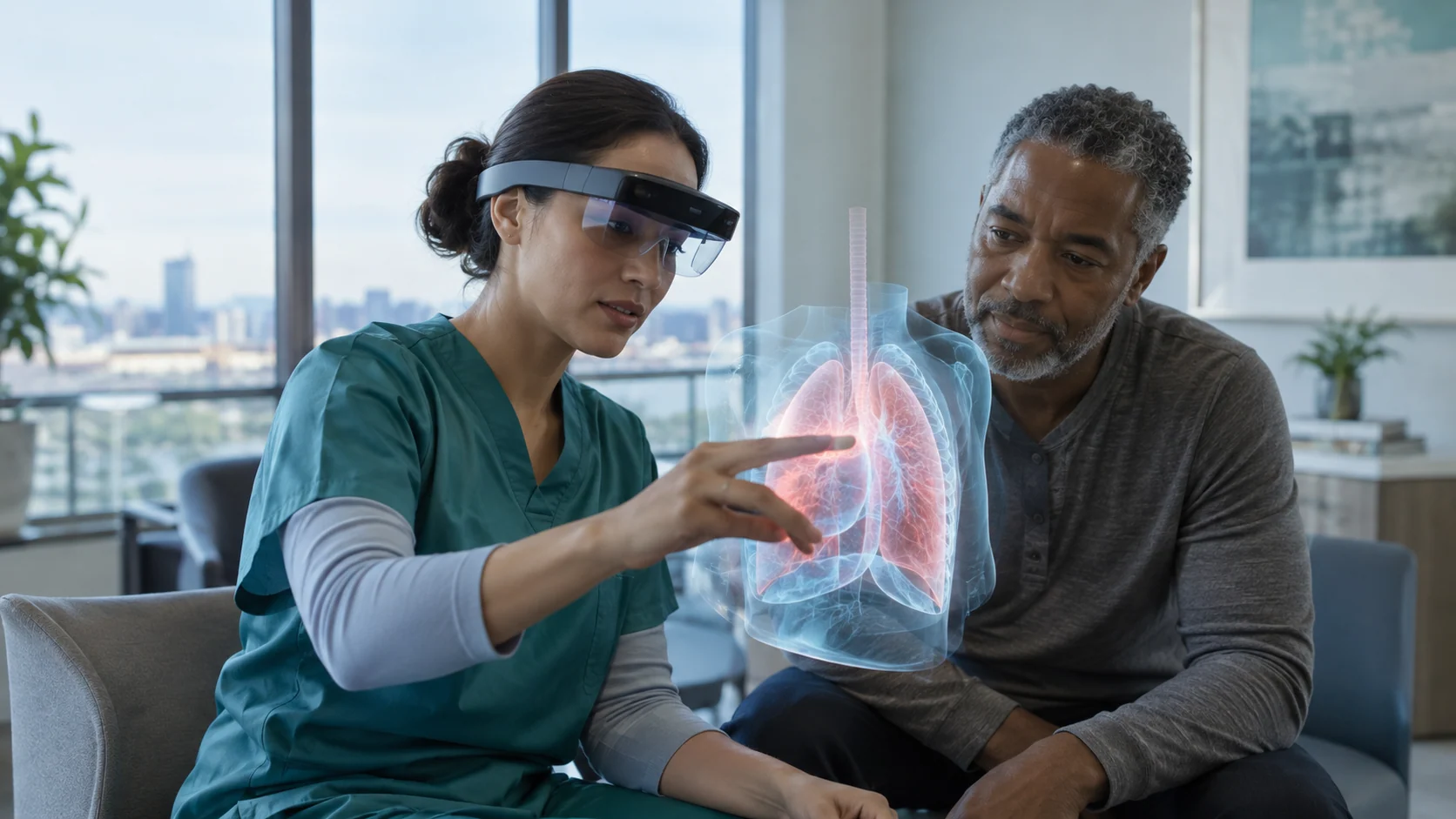
 INSIGHTS
How Augmented Reality for Healthcare Supports Doctors and Students
Augmented Reality (AR) is rapidly becoming one of the most transformative tools in modern medicine. Unlike Virtual Reality (VR), which immerses…
Read article ↗ INSIGHTS
Why Hospitals Are Rapidly Adopting AR in Healthcare for Accuracy and Efficiency?
Augmented Reality is no longer viewed as an experimental tool in healthcare. Hospitals across the world are integrating AR into clinical…
Read article ↗