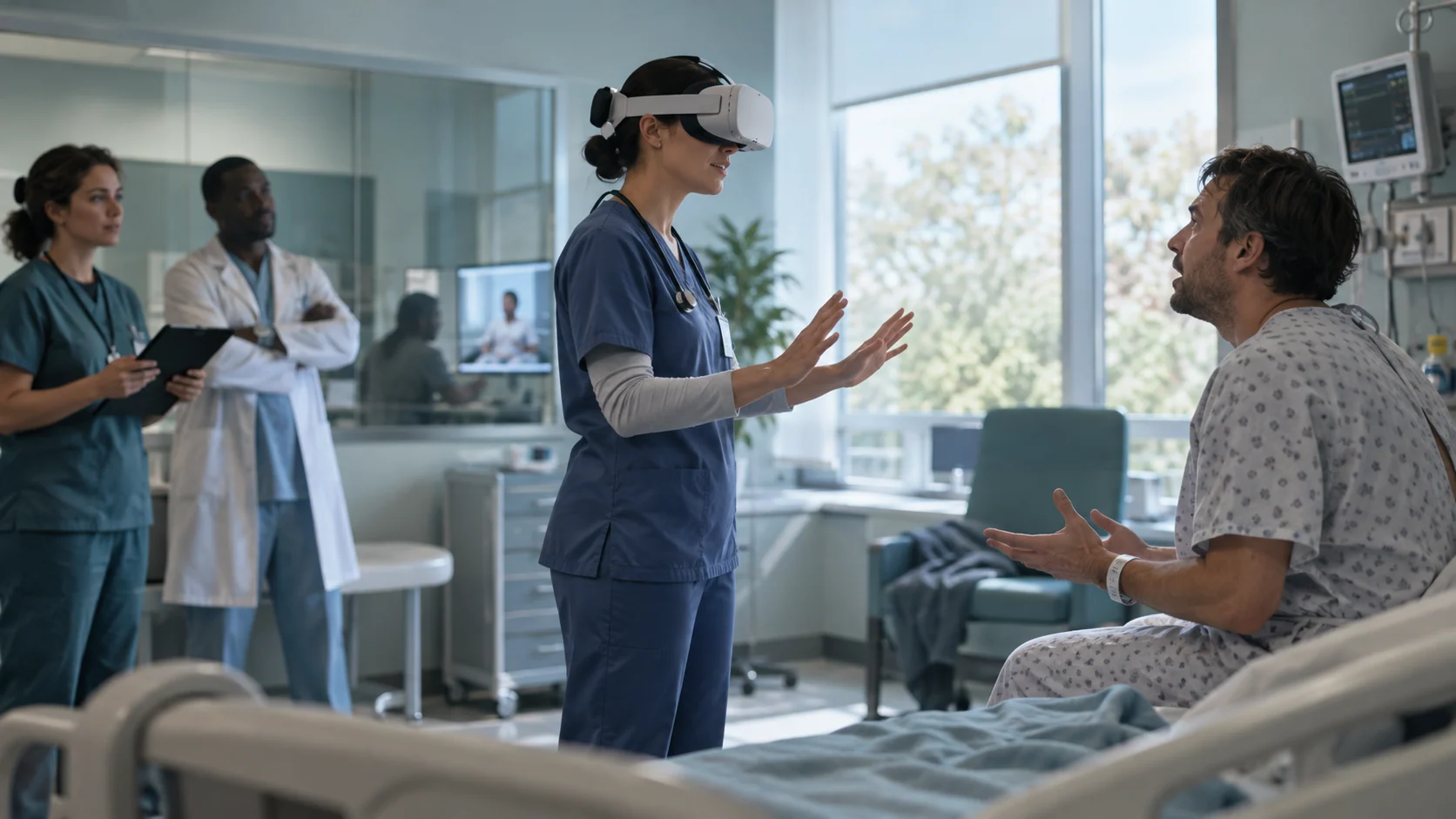
How Can VR De-Escalation Training Protect Healthcare Workers?
VR de-escalation training offers a practice setting, but whether a program supports worker safety requires a separate evaluation. This article is for hospital safety and training teams defining measures, review periods and the limits of a pilot. It complements the curriculum and technique guides with an evaluation plan.
Separate training performance from workplace measures
Record learner participation, observed practice behaviors and the quality of debriefing as training measures. Review workplace reports through the organization’s existing safety process, with attention to changes in staffing, exposure and reporting practice. A change in report volume alone does not explain its cause.
Agree who reviews the results and which contextual information accompanies them. Present the limitations of a small pilot explicitly. Use findings to improve training and support arrangements without claiming that completing a scenario guarantees safety during a real encounter.
Which healthcare scenarios are best suited to VR?
The best scenarios are consequential, difficult to rehearse frequently, and dependent on human behaviour rather than a single technical action. They should also be specific enough to produce observable decisions. A generic “angry patient” is less useful than a realistic emergency-department scenario involving pain, a long wait, uncertain information, family tension, noise, and competing clinical priorities.
Emergency departments: responding to distress, intoxication, long waits, pain, crowding, or escalating family members.
Behavioural health: trauma-informed communication, personal-space awareness, team coordination, and safe boundary setting.
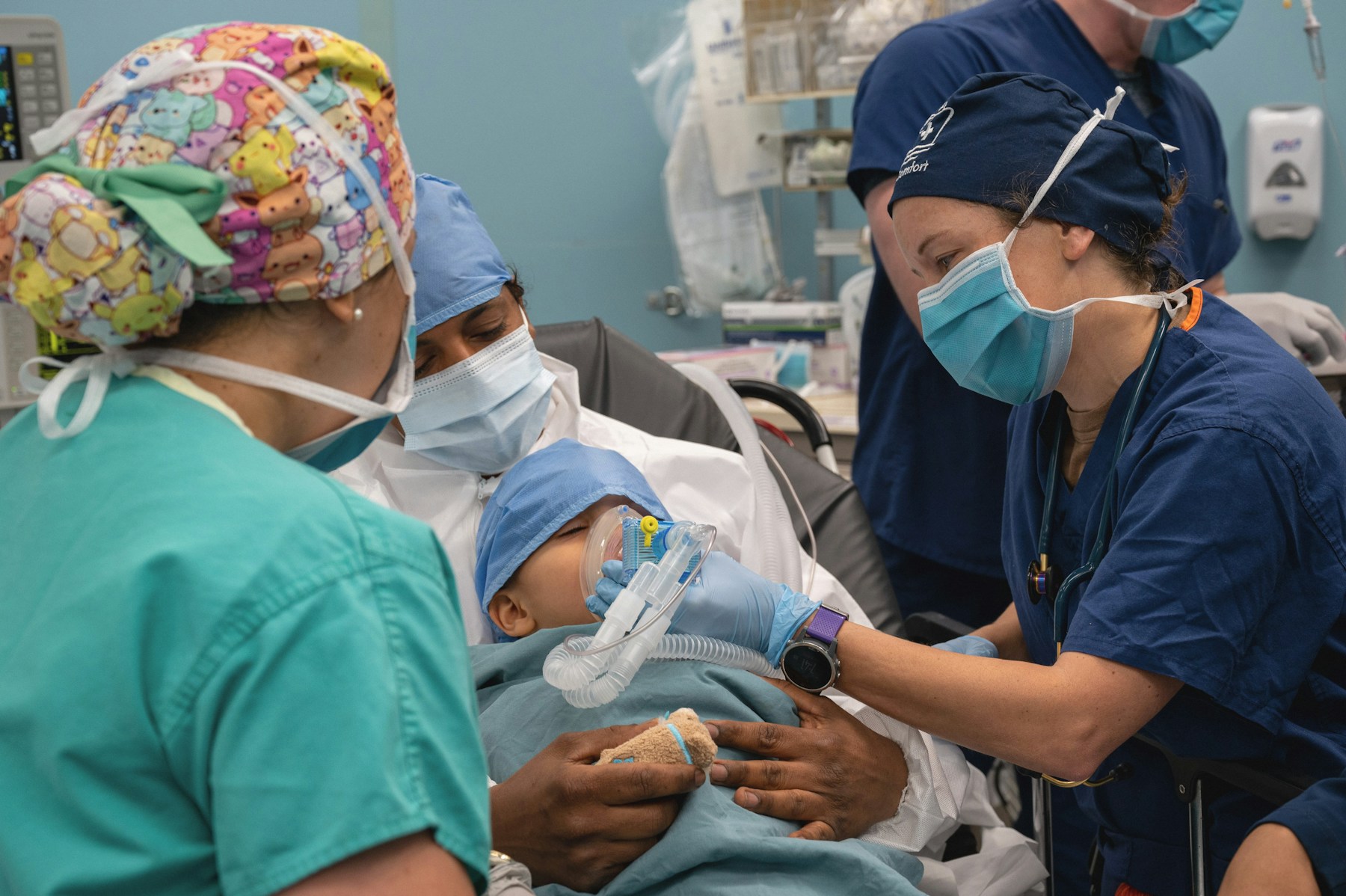
Paediatrics: supporting a distressed child while communicating with caregivers and minimising sensory overload.
Dementia and delirium care: recognising confusion, reducing demands, simplifying communication, and avoiding confrontation.
Reception and outpatient care: managing appointment disputes, privacy concerns, frustration, and service limitations.
Home and community care: maintaining situational awareness when staff have fewer immediate supports.
Interprofessional response: coordinating clinical, security, social-work, interpreter, and leadership roles.
Post-incident learning: reconstructing a near miss without using a real patient as the training environment.
A scenario library should represent different ages, cultures, communication needs, disabilities, languages, and care contexts without relying on stereotypes. It should also include successful early interventions, not only dramatic crises. Learners need to see that a calm explanation, environmental adjustment, interpreter, pain review, or realistic choice can change the trajectory.
Mimic Health XR’s broader work in healthcare applications and multisensory VR medical training shows how environments, avatars, tracking, and feedback can be combined. For de-escalation, realism should serve the learning objective. More visual detail is not automatically better if it distracts from communication cues or makes the experience unnecessarily intense.
How should hospitals measure results and scale a program?
Start with a focused pilot tied to a defined operational problem. A hospital might choose emergency-department communication, behavioural-health intake, or front-desk escalation because incident reviews show a recurring pattern. Select a representative learner group, establish baseline measures, run the intervention, gather qualitative feedback, and decide in advance what evidence would justify revision or expansion.
Useful measures exist at several levels. Reaction measures include usability, relevance, simulator comfort, and psychological safety. Learning measures include knowledge, cue recognition, decision quality, communication behaviours, and confidence. Behaviour measures ask whether skills transfer to observed practice. Operational measures may include staff calls for assistance, incident patterns, injuries, restraint use, complaints, near misses, time to escalation, or consistency with policy.
Leaders should avoid claiming that a short pilot “prevents violence” solely because learners enjoyed it or reported higher confidence. Workplace violence is influenced by staffing, environment, waiting times, care access, security design, reporting culture, and patient needs. VR can strengthen skills, but it cannot compensate for unsafe systems. Combine training data with broader safety and quality-improvement work.
A practical rollout can build on the organisation’s existing virtual reality healthcare training strategy. Begin with one role and scenario, refine the debrief guide, confirm device operations, and then add controlled variations. Maintain version records so scenario changes, policy updates, and scoring adjustments are traceable.
Define the safety or communication problem and identify the affected roles.
Co-design one scenario with frontline staff and clinical governance.
Set baseline behavioural and operational measures before training.
Pilot with trained facilitators and provide an accessible alternative.
Review learner feedback, technical data, debrief notes, and unintended effects.
Revise the scenario, validate it again, and only then expand to new units.
Reassess content after policy, workflow, demographic, or technology changes.
When scaling across sites, standardise the competencies while allowing local details to change. The learning objective may stay constant, but room layout, referral pathways, emergency codes, staffing models, languages, and legal obligations can differ. A configurable platform is more sustainable than a single fixed experience.
This site loads images and fonts from external services. Any cookies or analytics already configured operate independently of this notice. Dismiss saves only this notice’s dismissed state in your browser. It does not change tracking settings or send a consent choice to any service. If browser storage is unavailable, dismissal lasts only for the current page.