Virtual Reality Medical Training for Healthcare De-Escalation
Producing a VR de-escalation scenario involves more than creating a convincing character. This guide focuses on the production brief, dialogue branches, animation cues and educator review. The intended readers are simulation producers and clinical content owners working from an approved training objective.
Create a scenario production and review checklist
Write the role, setting and learning objective before building dialogue. For each branch, identify the learner input, the character response and the point at which a facilitator can pause the experience. Ask educators to review scripts and character behavior before motion, voice and environment production are finalized.
Keep a version record of approved dialogue, performance cues and reviewer feedback. Test whether learners can perceive the intended cues with the supported devices and accessibility options. Review revisions against the learning objective so additional realism does not distract from the practice task.
How Immersive De-Escalation Simulation Works
A strong simulation begins with a credible situation rather than impressive technology. The scenario might involve an anxious relative in an emergency department, a confused older patient resisting care, a distressed young person, or a patient frustrated by an unexpected delay. The setting, dialogue and escalation pattern should reflect the organisation’s actual challenges.
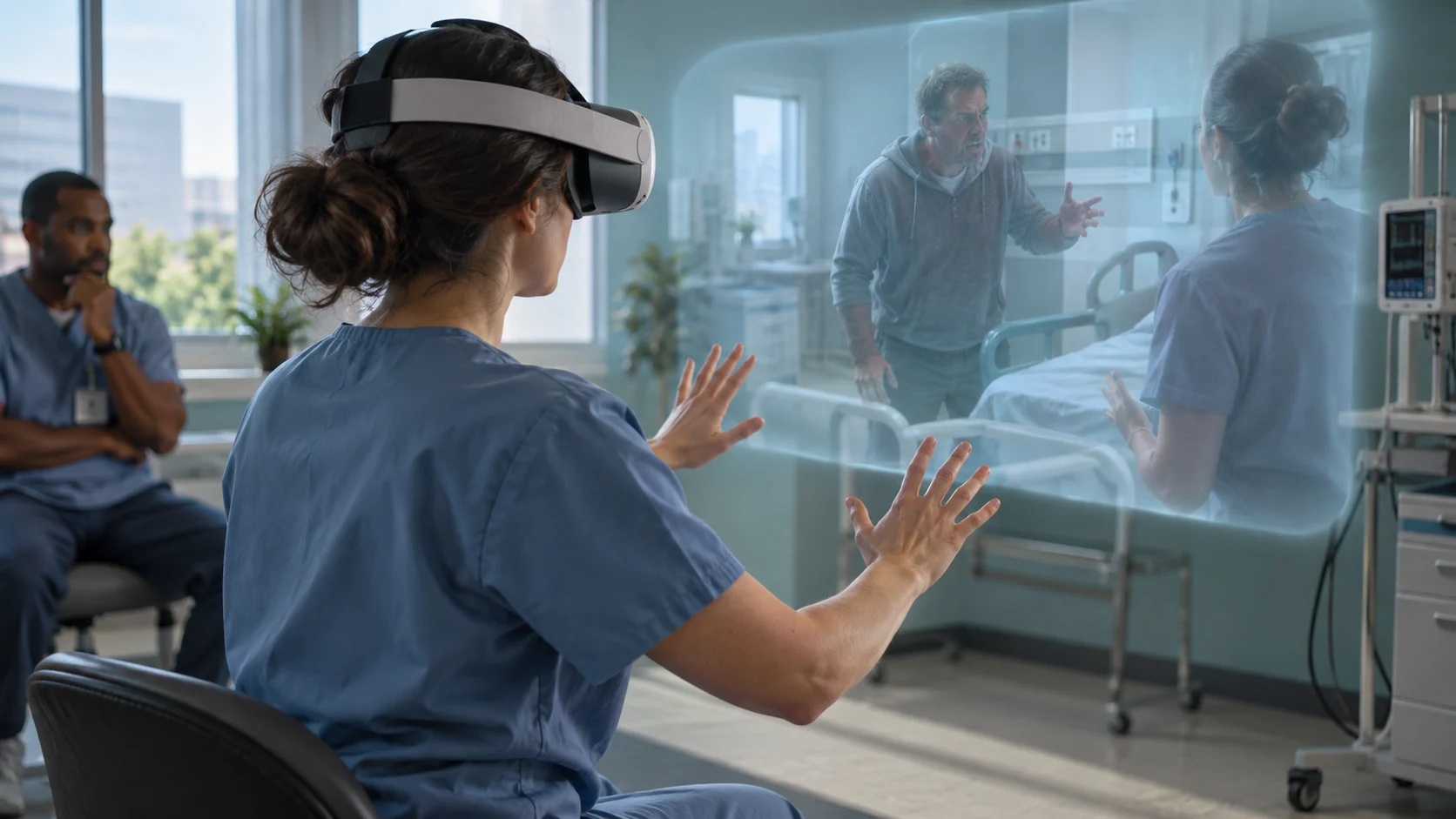
At the start, the learner receives a concise briefing: their role, immediate objective, available resources and relevant safety boundaries. Once the experience begins, a virtual character responds to spoken language, timing, proximity or selected actions. Branching logic changes the scene according to the learner’s decisions. Helpful choices may reduce tension; dismissive or rushed choices may increase it.
The experience can draw on virtual, augmented and mixed reality technology as well as conversational AI. A digital human may display facial expression, gaze, posture and vocal changes that give the learner clinically meaningful cues. The scenario does not need endless possibilities; it needs carefully authored decision points that connect directly to the learning objectives.
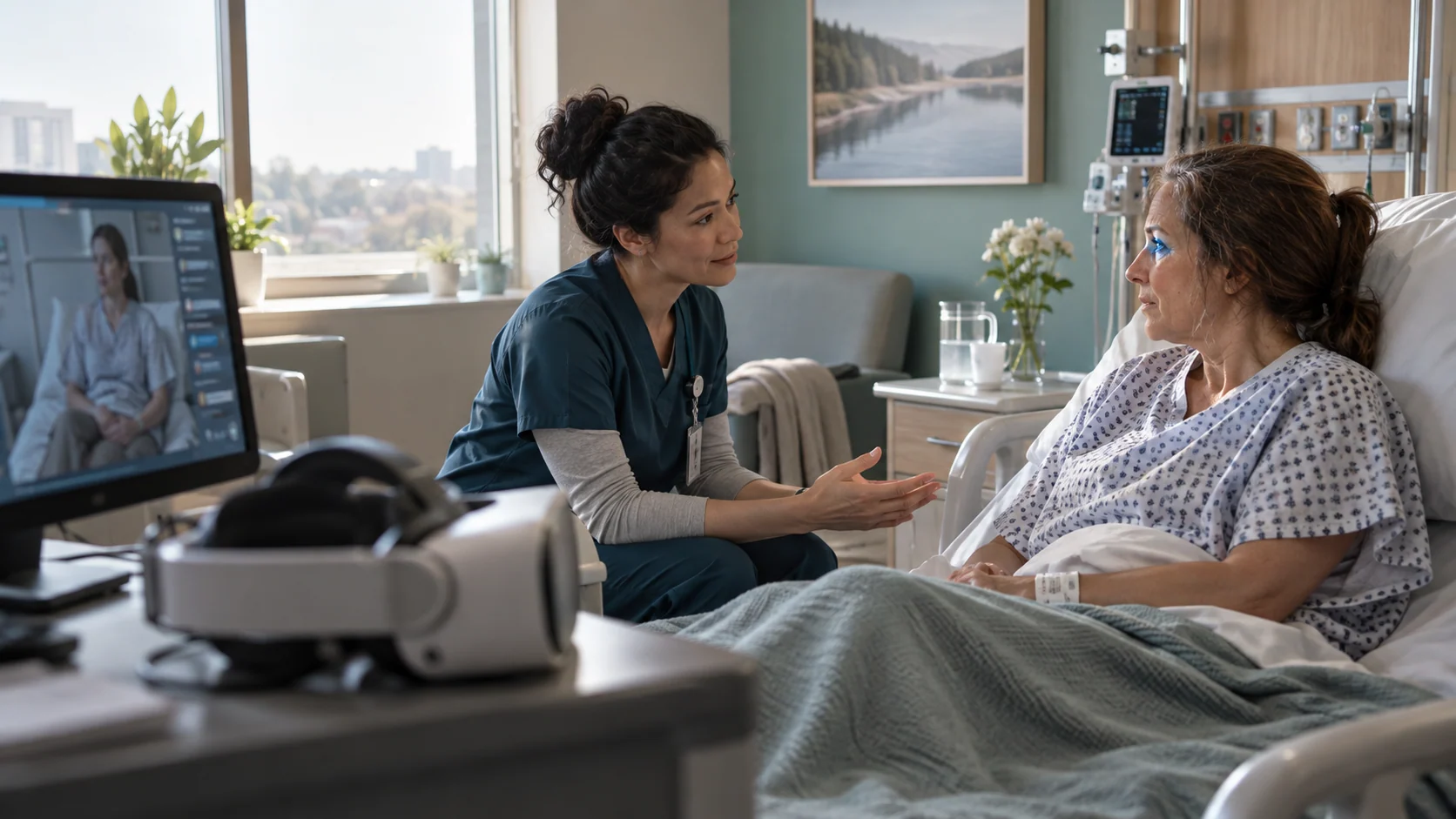
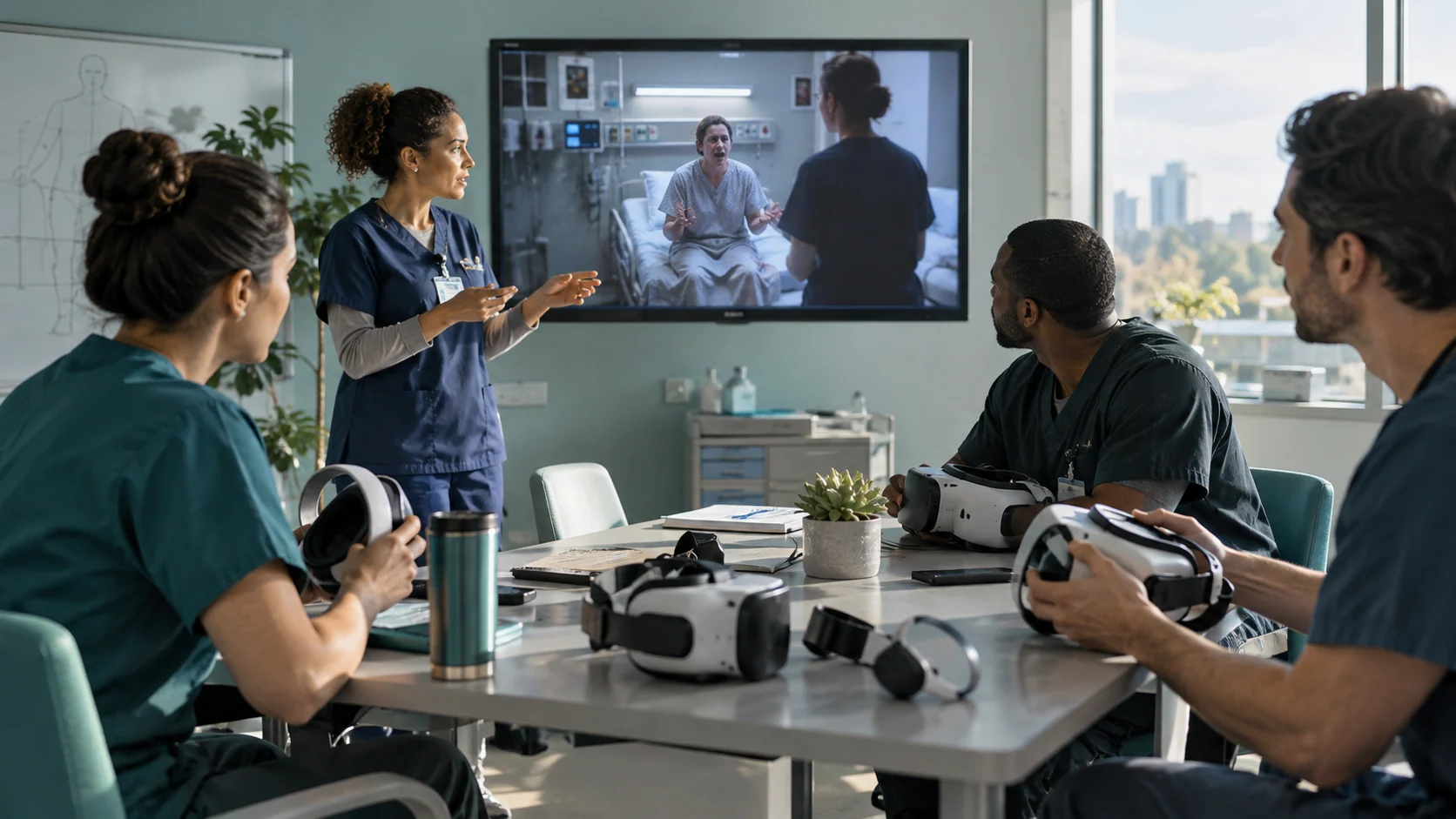
Feedback is the second half of the experience. An immediate debrief can replay key moments, show the path taken and invite reflection. A facilitator may ask what the learner noticed, what they intended, how the patient responded and what they would change. This is where an engaging simulation becomes purposeful learning.
A repeat attempt then turns reflection into behaviour. The learner can try a different opening statement, slow the interaction, acknowledge emotion earlier or request support sooner. Because the scenario is standardised, educators can compare attempts while still coaching the individual rather than reducing the session to a pass-or-fail test.
Skills Healthcare Teams Can Practise Safely
Virtual reality medical training is especially valuable for skills that combine perception, communication and judgement. De-escalation depends on all three. Learners need to notice what is happening, select an appropriate response and deliver it in a way that feels respectful and credible.
Situational awareness: identifying changes in voice, movement, facial expression, personal space and environmental risk.
Self-regulation: controlling posture, pace and tone so the clinician does not unintentionally intensify the interaction.
Active listening: reflecting concerns, checking understanding and distinguishing the person’s immediate need from the surface complaint.
Clear choices: offering realistic options without making promises the team cannot keep.
Boundary setting: communicating limits firmly, respectfully and consistently.
Team coordination: calling for assistance, sharing observations and handing over without creating confusion.
Trauma-informed practice: protecting dignity, reducing avoidable triggers and preserving the person’s sense of agency.
Post-incident reflection: recognising what worked, what changed the trajectory and where organisational factors contributed.
Different roles can practise the same event from different perspectives. A receptionist may focus on early recognition and calling support. A nurse may manage communication and clinical needs. A security colleague may consider positioning and least-restrictive intervention. A team scenario can then test whether those roles coordinate effectively.
Mimic Health XR’s broader healthcare applications show how immersive tools can support medical education, rehabilitation and patient engagement. For de-escalation, the same human-centred design principle matters: technology should support the relationship and the learning goal, not distract from them.
Scenarios should also represent diversity. Age, disability, language, culture, sensory needs and previous experiences can affect how a person interprets a healthcare encounter. Inclusive scenario design helps teams practise flexible communication rather than memorising one supposedly universal response.
How to Design an Effective VR Training Programme
A successful programme starts with a specific performance problem. “Improve communication” is too broad. A stronger objective might be: staff will recognise three early signs of escalation, acknowledge the person’s concern, offer two appropriate options and request support according to local policy. Clear objectives guide every design decision.
Next, collect evidence from the workplace. Review incident themes, staff feedback, patient experience data and existing training. Interview frontline employees about where conversations become difficult and which organisational constraints matter. Co-design protects against scenarios that look plausible to developers but feel artificial to clinicians.
The development team should connect the programme to the organisation’s custom XR and AI capabilities and its established clinical education. It can also use emotion-aware AI avatars when dialogue and nonverbal response are central to the learning experience.
Define the target learners, setting and operational risk.
Write observable learning outcomes and map each to a decision point.
Develop dialogue with clinical, education, safety and lived-experience input.
Build a short prototype before producing multiple scenarios.
Test usability, psychological safety, accessibility and clinical credibility.
Train facilitators to conduct consistent, reflective debriefs.
Pilot with a small cohort, revise, and only then expand.
Psychological safety requires particular attention. Learners should know that the simulation is a learning space, how performance data will be used and when they may pause. Content warnings and opt-out arrangements may be appropriate for scenarios involving aggression or trauma. A facilitator should be prepared to support participants who find the material personally difficult.
Hardware decisions come after the learning design. Standalone headsets can simplify deployment, while higher-end systems may support advanced tracking or visual fidelity. The right choice depends on scale, hygiene requirements, available space, IT governance, accessibility and the interaction model—not on novelty.
This site loads images and fonts from external services. Any cookies or analytics already configured operate independently of this notice. Dismiss saves only this notice’s dismissed state in your browser. It does not change tracking settings or send a consent choice to any service. If browser storage is unavailable, dismissal lasts only for the current page.