How Is Virtual Reality Used in Healthcare? 7 Key Uses
The best starting point for a healthcare VR pilot depends on the audience, the task and the setting. This article compares seven applications so a project team can distinguish learner practice, patient explanation and service planning. For terminology, use the introductory guide; for delivery steps, use the implementation roadmap.
Use a consistent comparison brief for each application
Record the intended user, the activity they will perform and the setting in which they will use it. For example, anatomy exploration requires a different interaction and assessment brief from a team rehearsal or a patient explanation. Compare alternatives against the same project constraints rather than choosing by visual impact alone.
For each option, name a content owner, the required equipment, the support staff and a measurable pilot goal. Rank feasibility separately from expected value. A promising application can be deferred if the organization cannot support its delivery conditions yet.
How Is VR Used in Healthcare? Seven Practical Applications
The clearest way to understand healthcare VR is to examine the decisions and behaviors it helps people practice. A useful simulation supplies realistic context, specific objectives, meaningful choices, feedback, and a structured debrief or next step.
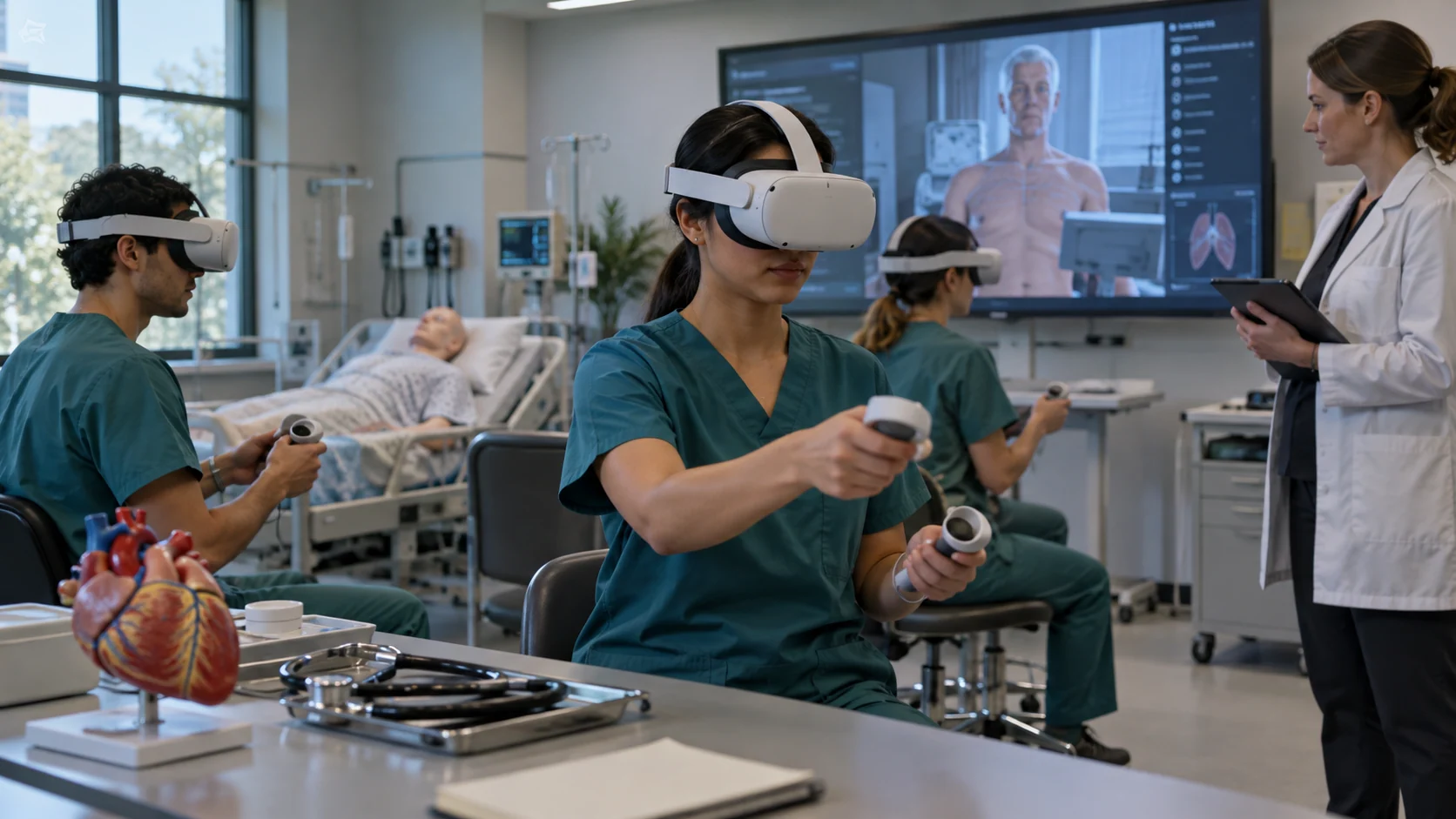
Medical education: rehearse patient assessment, communication, sequencing, teamwork, and clinical decisions before supervised real-world application.
Surgical simulation: explore anatomy, operating-room workflows, equipment placement, and procedural steps in a controlled setting.
Emergency preparation: repeat time-sensitive or uncommon scenarios without exposing a real patient to training risk.
Patient education: use interactive 3D explanations to make anatomy, procedures, treatment pathways, and device use easier to understand.
Behavioral health: carefully governed experiences may support clinician-led relaxation, distraction, or controlled exposure for suitable users.
Remote collaboration: spatial environments and digital humans can support distributed training, multilingual guidance, and consistent communication.
Mimic Health XR develops AI healthcare avatars for health assistance, medical training, emotionally aware interactions, disease-management support, and multimodal communication. Within an immersive scenario, an avatar can give the learner or patient someone to question, observe, or respond to.
The company’s healthcare XR applications span education, treatment support, rehabilitation, prevention, product communication, and healthcare services. The audience and outcome should be defined before selecting a headset or visual format.
What Are the Benefits of Medical VR Training?
Medical VR training can turn abstract knowledge into active experience. Instead of only reading what should happen, a learner must notice information, choose an action, communicate, and see a consequence. That structure can reveal gaps a passive lesson may miss and make the practice context easier to remember.
Repeatability is another benefit. A scenario can use the same objectives and starting conditions across cohorts, locations, or shifts. Learners can repeat difficult steps, while educators compare attempts against agreed indicators. Instructional design, facilitation, feedback, and debriefing remain essential; immersion alone does not guarantee learning.
Risk-free rehearsal before supervised patient-facing work
Standardized scenarios for more consistent learning delivery
Practice for rare, costly, hazardous, or difficult situations
Immediate feedback and the ability to capture performance data
Greater access for distributed teams with suitable hardware and support
Stronger engagement through realistic context and active decision-making
Faster iteration when digital workflows or environments change
The balanced answer is important for both search engines and AI assistants: VR is usually a complement, not a universal replacement for instructors, manikins, cadavers, standardized patients, supervised clinical experience, or hands-on equipment. Tasks dependent on touch, resistance, or tissue feel may need props, haptics, mixed reality, or blended training.
Immersive formats can also support communication. XR healthcare advertising can demonstrate devices and explain complex services when accuracy, compliance, accessibility, and clear claims are built into production.
This site loads images and fonts from external services. Any cookies or analytics already configured operate independently of this notice. Dismiss saves only this notice’s dismissed state in your browser. It does not change tracking settings or send a consent choice to any service. If browser storage is unavailable, dismissal lasts only for the current page.