
← All insights

Healthcare journal

Virtual Reality in Healthcare: Use Cases & Implementation

Healthcare professional preparing for a virtual reality healthcare implementation program

Once a healthcare VR use case has been selected, the work shifts to delivery: ownership, content review, equipment, integration and acceptance criteria. This guide is for project leads taking a defined proposal into a pilot. Its 90-day roadmap should be adapted to the organization’s review process and available resources.

Agree the pilot exit criteria before production

Write a short acceptance plan with the project sponsor, content owner and delivery team. Specify which tasks the prototype must support, what reviewers will inspect and which issues prevent release. Record dependencies such as device availability, content approval and staff time with named owners.

At the end of the pilot, decide whether to revise, extend or stop. The decision record should include unresolved issues, support needs and the evidence collected against the original criteria. Keep the pilot’s goals separate from longer-term clinical or operational claims that it was not designed to test.

Clinician using a virtual reality headset for healthcare training

How to Choose the Right First Project


A first project should be meaningful enough to matter and bounded enough to evaluate. Avoid beginning with an enterprise-wide promise. Choose one workflow, one audience, one setting, and one decision about what success looks like.

Good pilot candidates are repeated frequently, expensive or difficult to simulate physically, risky to practice on real patients, or dependent on spatial understanding. They should also have an identifiable owner who can recruit users and act on the results.

Concept illustration: Virtual Reality in Healthcare: Use Cases & Implementation

Write the use case as an outcome statement: “New emergency nurses will complete the isolation-room sequence with fewer missed steps,” or “Patients will explain the treatment pathway more accurately after the education session.” This is stronger than “We want a VR module.”

Before selecting a vendor, score the project against clinical relevance, user volume, content stability, hardware constraints, measurement feasibility, accessibility, and internal sponsorship. A technically impressive project with no operational owner usually stalls after the demo.

Designing Safe and Realistic Clinical Experiences


Clinical credibility begins with subject-matter experts. Involve clinicians, educators, safety leads, and representative users early. They should review objectives, terminology, equipment, decision points, consequences, and debriefing prompts.

Realism must serve learning or care—not decoration. Accurate timing, meaningful choices, believable behavior, and clear feedback matter more than filling every surface with visual detail. Users should understand what they are expected to do and why.

Build comfort and accessibility into the design. Offer seated modes when appropriate, readable text, subtitles, adjustable audio, simple controls, hygiene procedures, and a clear way to pause or exit. Screen users for motion sensitivity and relevant clinical contraindications.

For training, a structured debrief is often where experience becomes learning. Capture the learner’s actions, then help an instructor discuss reasoning, teamwork, priorities, and alternative choices without using the simulation as punitive surveillance.

Technology, Integration, and Data Requirements


Start with the operating environment. Decide whether the experience will run on standalone headsets, tethered workstations, tablets, or mixed-reality devices. Check room size, charging, storage, cleaning, network access, device management, and support ownership.

Doctor and patient discussing a safe technology-supported healthcare experience

Then define the information flow. A training pilot may only need anonymized learner IDs and completion records. A clinical application may touch protected health information, scheduling, identity, or medical records and therefore require deeper privacy, security, and governance review.

Ask vendors how data are collected, encrypted, retained, exported, and deleted; where services are hosted; who can access administrative dashboards; how roles are managed; and what happens when a device is lost. Confirm whether offline operation is available for sensitive or unreliable environments.

Mimic Health XR combines the underlying XR, scanning, and motion-capture technology needed for spatial healthcare experiences, but each implementation should select only the components required by the outcome.

Interoperability should be proportional to the pilot. Avoid delaying a learning experiment with unnecessary enterprise integration, but do not ignore a required learning-management-system export or identity workflow. Document what is essential for launch and what can follow after evidence of value.

Measuring Outcomes and Return on Investment


Measurement should begin before content production. Capture a baseline using the same definitions you will use after launch. Measures may include completion time, missed critical steps, knowledge retention, confidence, patient comprehension, instructor hours, travel, equipment use, or time away from clinical duties.

Separate activity from outcome. Headset sessions and module completions show adoption, not effectiveness. Pair usage with a performance measure and, where possible, compare results with the current training or education method.

Calculate total cost across content design, clinical review, hardware, licenses, integration, device management, hygiene, training, support, updates, and replacement. Compare that with avoided lab time, reduced travel, instructor capacity, faster onboarding, fewer consumables, or improved throughput.

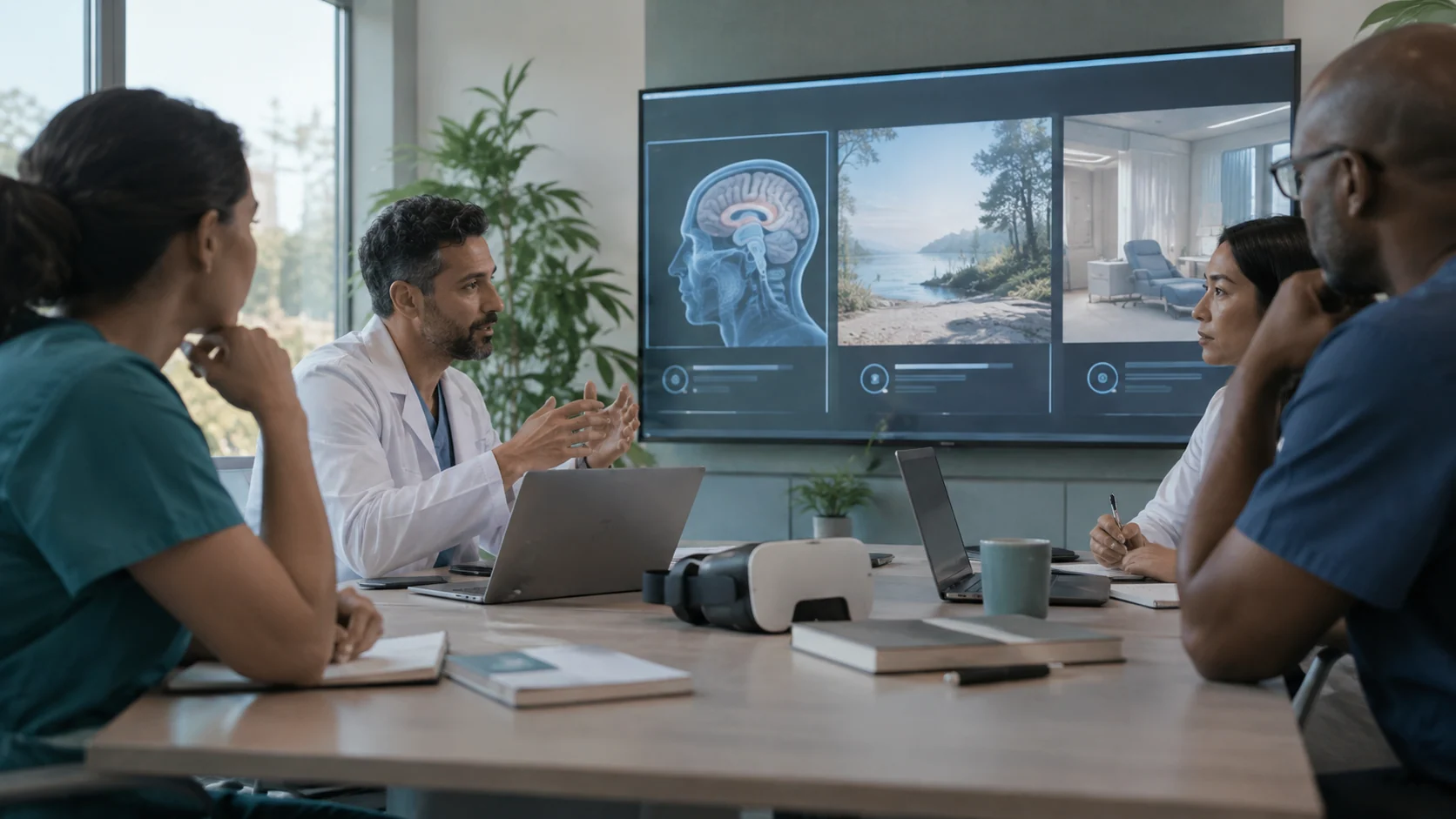
Healthcare professional reviewing digital requirements for an immersive clinical program

Use leading and lagging indicators. Early indicators—completion, usability, confidence, and errors inside the simulation—help teams improve quickly. Later indicators—retention, observed behavior, patient understanding, or savings—show whether value persists.

A Practical 90-Day Implementation Roadmap


Days 1–15: Define. Name the workflow, audience, owner, baseline, target outcome, and constraints. Interview users, map the current process, identify risks, and agree on the smallest credible scenario.

Days 16–35: Design. Write objectives, decisions, feedback, accessibility requirements, and data rules. Create a simple storyboard or prototype and review it with clinical experts and end users before building the full experience.

Days 36–60: Build and validate. Produce the scenario, test hardware and device management, complete security and safety reviews, and run structured usability sessions. Correct clinical inaccuracies and confusing interactions before broader access.

Days 61–75: Pilot. Train facilitators, recruit a representative cohort, record baseline and pilot measures, observe sessions, and capture qualitative feedback and performance data.

Days 76–90: Decide. Compare results with success criteria. Document what worked, what failed, cost per user, support demands, and required changes. Scale only if evidence supports it; otherwise refine the content or choose a better-fit use case.

Review Mimic Health XR’s healthcare applications to identify a focused starting point across training, patient engagement, rehabilitation, remote care, and visualization.

Related reading

Back to insights