Infection Control Training with VR: A Hospital Guide
This guide is for infection-prevention educators planning VR practice around PPE, hand hygiene, contamination awareness and isolation workflows. The clinical team’s approved protocols remain the content source. Broader emergency response, handoff and equipment-safety scenarios belong in the separate hospital safety guide.
Review the scenario against the current protocol
Name the protocol version and the infection-prevention reviewer in the scenario brief. Map each learning objective to an observable decision or action, then identify what the interface can represent faithfully and what requires an alternative activity. Use educator review to resolve those limits before production.
During the pilot, record where learners misunderstand the interface separately from where they misunderstand the protocol. Revisit the scenario whenever the underlying training material changes. Do not let a software completion screen replace the organization’s existing competency assessment.
How VR Infection Control Training Works
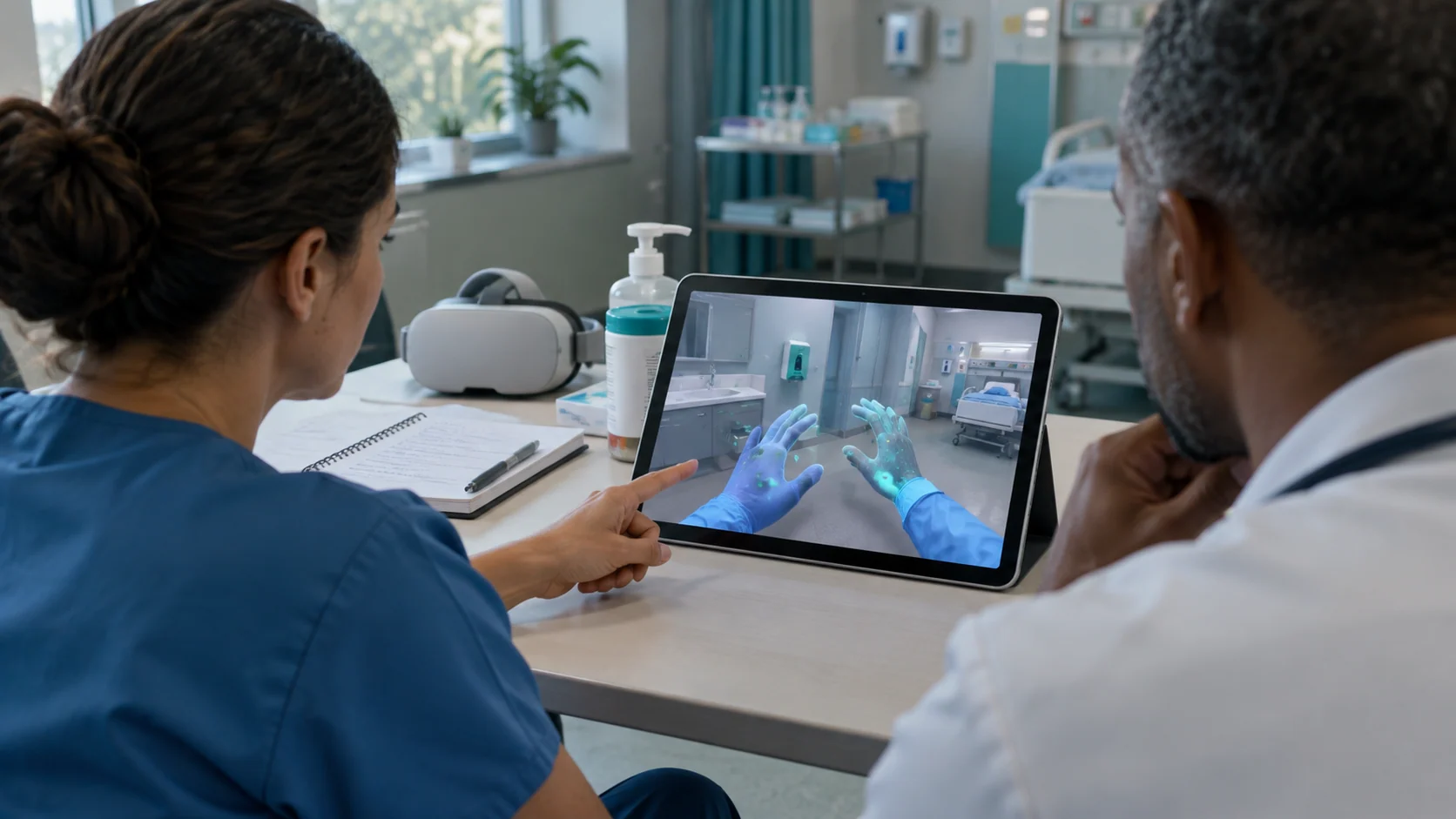
A VR infection-control module places the learner inside a realistic care environment and asks them to act rather than simply recognize an answer. The experience might begin outside an isolation room, continue through patient assessment and equipment use, and end with doffing, waste handling, documentation, and hand hygiene. Every step can be connected to an educator-defined objective.
The environment can be delivered through a headset, desktop simulation, or mixed-reality format depending on the audience and setting. Mimic Health XR’s broader healthcare applications show how immersive tools can support medical education, hospital safety, rehabilitation, and patient communication. The technology choice should follow the learning task, not the other way around.
Strong modules use realistic cues without turning training into entertainment. A learner may hear an alarm, receive a question from a virtual patient, notice a glove tear, or discover that preferred supplies are not in the expected location. These events test prioritization and situational awareness. They also create useful moments for a facilitator-led debrief.
The simulation can record sequence, timing, missed steps, unnecessary contact, and escalation choices. Those signals do not automatically equal clinical competence, but they give educators a consistent evidence layer. A replay can show exactly where a learner crossed a clean boundary or removed equipment in the wrong order, making feedback specific rather than general.
AI-powered virtual patients can add communication practice when carefully constrained. The Mimic Health XR AI avatar services can support patient questions, colleague handoffs, and multilingual explanation. Clinical rules and scoring should remain authored and reviewed by qualified educators, with AI used as an interaction layer rather than an authority.
Infection-Prevention Scenarios to Simulate
The best first scenario is not necessarily the most dramatic. It is a workflow with clear actions, frequent exposure, meaningful consequences, and enough variation to justify repeated practice. Hospitals should choose one priority that connects to existing policy, audit findings, incident reviews, or staff feedback.
Personal protective equipment is an obvious starting point because the sequence can be observed and coached. A scenario can test equipment selection, donning, patient interaction, contamination awareness, doffing, disposal, and hand hygiene. Variants can introduce a missing item, an urgent patient need, or an interruption without changing the core learning objective.
Hand-hygiene scenarios can move beyond a single demonstration. Learners identify moments when hygiene is required as they enter, examine, reposition, document, and exit. Environmental-cleaning scenarios can focus on high-touch surfaces, equipment transfer, room turnover, and communication between clinical and support teams.
More advanced modules can connect infection control with emergency response. The existing Mimic Health XR article on emergency response training in XR provides a useful foundation for scenarios where isolation precautions must be maintained while a team manages deterioration.
Each scenario should make the safe path clear and allow controlled mistakes. The goal is not to surprise learners with hidden traps. It is to create deliberate practice where feedback, repetition, and reflection improve the next attempt.
Isolation-room entry and exit: Choose PPE, prepare supplies, preserve clean zones, and doff in the correct sequence.
Specimen handling: Collect, label, package, transfer, and document without contaminating surfaces.
Equipment transfer: Move shared tools between spaces while following cleaning and ownership rules.
Outbreak escalation: Recognize a pattern, communicate concerns, and activate the correct local response.
Patient education: Explain precautions clearly, respectfully, and in accessible language.
Team handoff: Transfer responsibility without losing critical infection-risk information.
Designing a Measurable Hospital Training Program
A useful program begins with one measurable behavior, not a hardware purchase. A hospital might target correct PPE sequencing, fewer clean-zone contacts, faster recognition of isolation requirements, or clearer escalation communication. The learning objective determines the environment, interactions, assessment rubric, and debrief questions.
Production teams can use the site’s advanced XR technology capabilities to build realistic rooms, equipment, digital humans, and performance tracking. Clinical educators should own policy interpretation, acceptable sequence, exceptions, and remediation. This shared authorship protects accuracy while keeping the experience usable.
Baseline measurement helps separate novelty from learning. Before the immersive module, educators can run a short knowledge check or observed workflow. During simulation, they can capture behavior-level indicators. After training, a repeat scenario tests retention. When appropriate, organizations can compare audit patterns or incident signals over time, while avoiding claims that a single simulation caused a clinical outcome.
Debriefing is where much of the value appears. Facilitators should ask what the learner noticed, why they chose an action, what competing demand influenced them, and how the environment helped or hindered safe behavior. A score alone cannot reveal reasoning. A structured conversation turns performance data into transferable insight.
Accuracy: Correct sequence, equipment choice, hand-hygiene moments, and contamination avoidance.
Efficiency: Time to prepare and act, interpreted alongside accuracy rather than as a speed contest.
Situation awareness: Recognition of signage, boundaries, missing supplies, and changing patient needs.
Communication: Clear instructions, handoffs, escalation, and patient-centered explanation.
Retention: Performance on a later scenario, not only immediately after the first session.
Transfer: Alignment with supervised observation and established quality processes in the workplace.
Implementation, Accessibility, and Governance
Clinical credibility depends on governance. Before launch, infection-prevention specialists, educators, frontline representatives, accessibility reviewers, and IT or privacy stakeholders should agree on objectives and boundaries. Policies differ across settings and jurisdictions, so a module should be configurable and version-controlled rather than presented as a universal protocol.
Start with a small pilot and a clearly defined cohort. Test the scenario with experienced staff who can identify unrealistic room details, missing workflow branches, unclear instructions, or scoring that rewards the wrong behavior. Then revise before using it for formal assessment. A technically impressive simulation that contradicts local practice can damage trust quickly.
Accessibility must be part of the design brief. Some learners experience motion sickness, have visual or hearing impairments, cannot use hand controllers comfortably, or need seated participation. Offer captions, adjustable audio, high-contrast cues, controller alternatives, comfort settings, and an equivalent desktop or facilitated pathway when possible. Accessibility determines whether the program reaches the workforce it is meant to support.
Data collection should be proportionate. Record only information needed for learning and quality improvement, define who can see individual results, set retention periods, and distinguish coaching data from employment assessment. If virtual patients or AI interactions are used, keep approved content, escalation rules, and limitations visible to facilitators.
A practical implementation can follow five stages: define the behavior, storyboard the workflow, build a limited prototype, validate with clinical experts, and pilot with structured debriefing. Teams exploring a custom program can review Mimic Health XR’s medical education and training approach and its focus on repeatable, measurable simulation.
Scale only after the pilot proves useful. Expansion may mean more roles, additional room layouts, multilingual patient interactions, or refresher scenarios—not simply longer sessions. The strongest program becomes a maintainable learning system that can adapt when policy, equipment, or risk patterns change.
This site loads images and fonts from external services. Any cookies or analytics already configured operate independently of this notice. Dismiss saves only this notice’s dismissed state in your browser. It does not change tracking settings or send a consent choice to any service. If browser storage is unavailable, dismissal lasts only for the current page.