← All insights

Healthcare journal

Simulation Debriefing in Healthcare: A Practical XR Guide

Concept illustration: Simulation Debriefing in Healthcare: A Practical XR Guide

How can healthcare teams turn an immersive simulation into safer decisions, stronger communication, and skills that transfer to clinical practice?


The learning value of a simulation does not end when the headset comes off or the scenario stops. Much of the value is created during the debrief, when participants reconstruct events, explain their thinking, examine evidence, and connect the experience with real clinical work.

This practical guide explains how to plan, facilitate, measure, and improve simulation debriefing in healthcare. It covers psychological safety, prebriefing, discussion structure, XR playback, team dynamics, governance, assessment, and transfer to practice.


Table of Contents

  1. Define the purpose of simulation debriefing

  2. Prepare the scenario and the debrief together

  3. Use a clear debriefing structure

  4. Use XR data and playback without losing context

  5. Facilitate difficult conversations and team learning

  6. Measure transfer and improve the debriefing program

  7. Frequently asked questions

  8. Conclusion


1. Define the Purpose of Simulation Debriefing


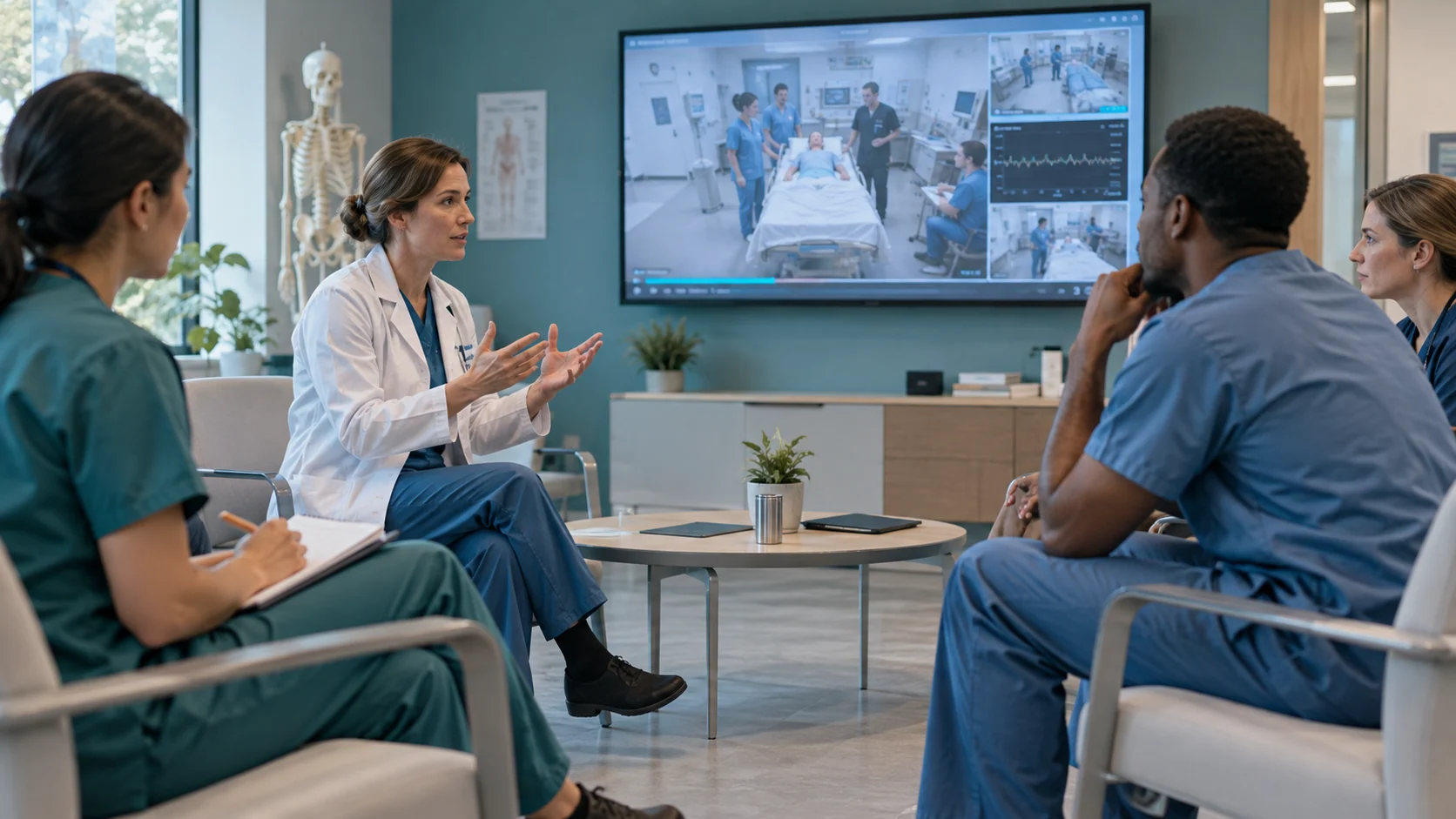
Simulation debriefing is the structured conversation that turns an experience into learning. Participants reconstruct what happened, examine the thinking behind their actions, connect choices with outcomes, and decide what to repeat or change. In healthcare, this reflection matters because technical skills, communication, workload, environment, and team coordination often influence the same event.

A debrief should have explicit learning objectives. A scenario about deterioration may focus on recognition, escalation, role allocation, closed-loop communication, or all four. Facilitators need to know which behaviours are essential and which events are included only to create realism. Without that distinction, discussion can become a chronological replay rather than a focused examination of performance.

Psychological safety is a prerequisite. Learners must be able to describe uncertainty, errors, and assumptions without expecting humiliation or punishment. Facilitators can establish this by acknowledging that capable professionals can make different decisions under pressure, explaining confidentiality, and separating the learning discussion from formal performance management unless assessment was clearly agreed in advance.
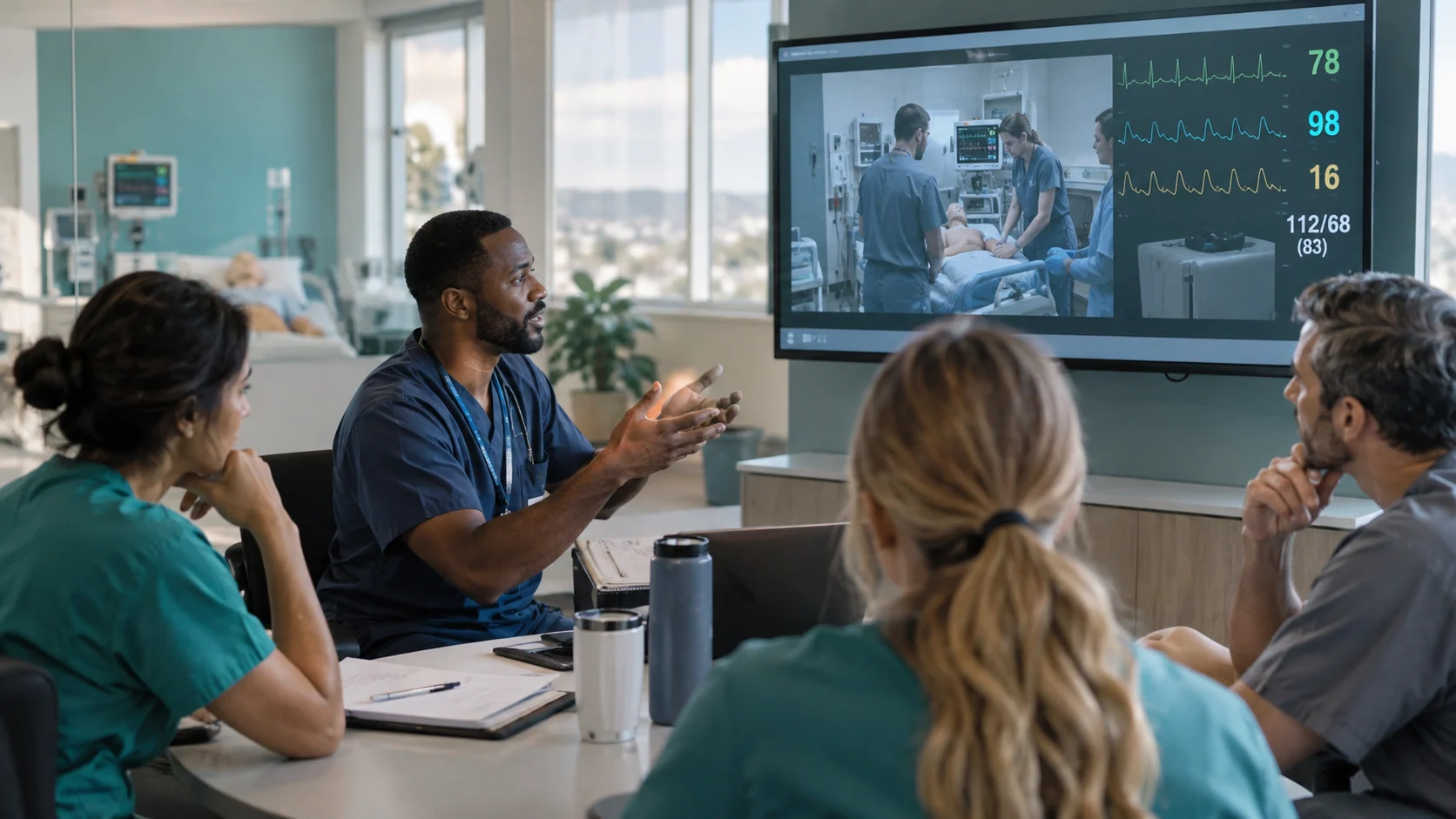
Concept illustration: Simulation Debriefing in Healthcare: A Practical XR Guide

Debriefing also needs operational purpose. Hospitals may use it to improve onboarding, rehearse rare events, validate new equipment, strengthen teamwork, or identify workflow risks. Recording that purpose helps educators choose the right participants, evidence, questions, and follow-up actions.

For the wider learning environment, see why healthcare simulations matter in modern medical education.


2. Prepare the Scenario and the Debrief Together


Debrief design should begin while the scenario is being built. For every objective, define the observable actions or communications that will provide evidence. Decide which vital signs, system logs, voice transcripts, timing data, or facilitator notes will help participants understand the event. Collect only evidence that supports learning and can be handled safely.

Create a prebrief that explains the simulation's purpose, fictional contract, technology limits, confidentiality, and expectations for participation. Learners should know how to pause for a real safety concern, how technical problems will be handled, and whether the activity is formative or assessed. Familiarity with controls and equipment reduces cognitive load unrelated to the clinical objective.

Plan the transition into discussion. Give participants a short moment to reset, attend to emotional reactions, and move from action mode to reflection. Confirm that the patient or event was simulated and check whether anyone needs support. This is especially important after scenarios involving death, violence, paediatric emergencies, discrimination, or traumatic experiences.

Facilitators should prepare a small number of priority questions and possible probes. They can adapt to what occurs, but a plan prevents the conversation from being dominated by the most vocal participant or the most dramatic moment. Reserve time for summary and practical commitments.

Teams building realistic environments can use the virtual reality healthcare implementation guide to align technology, safety, and workflow.

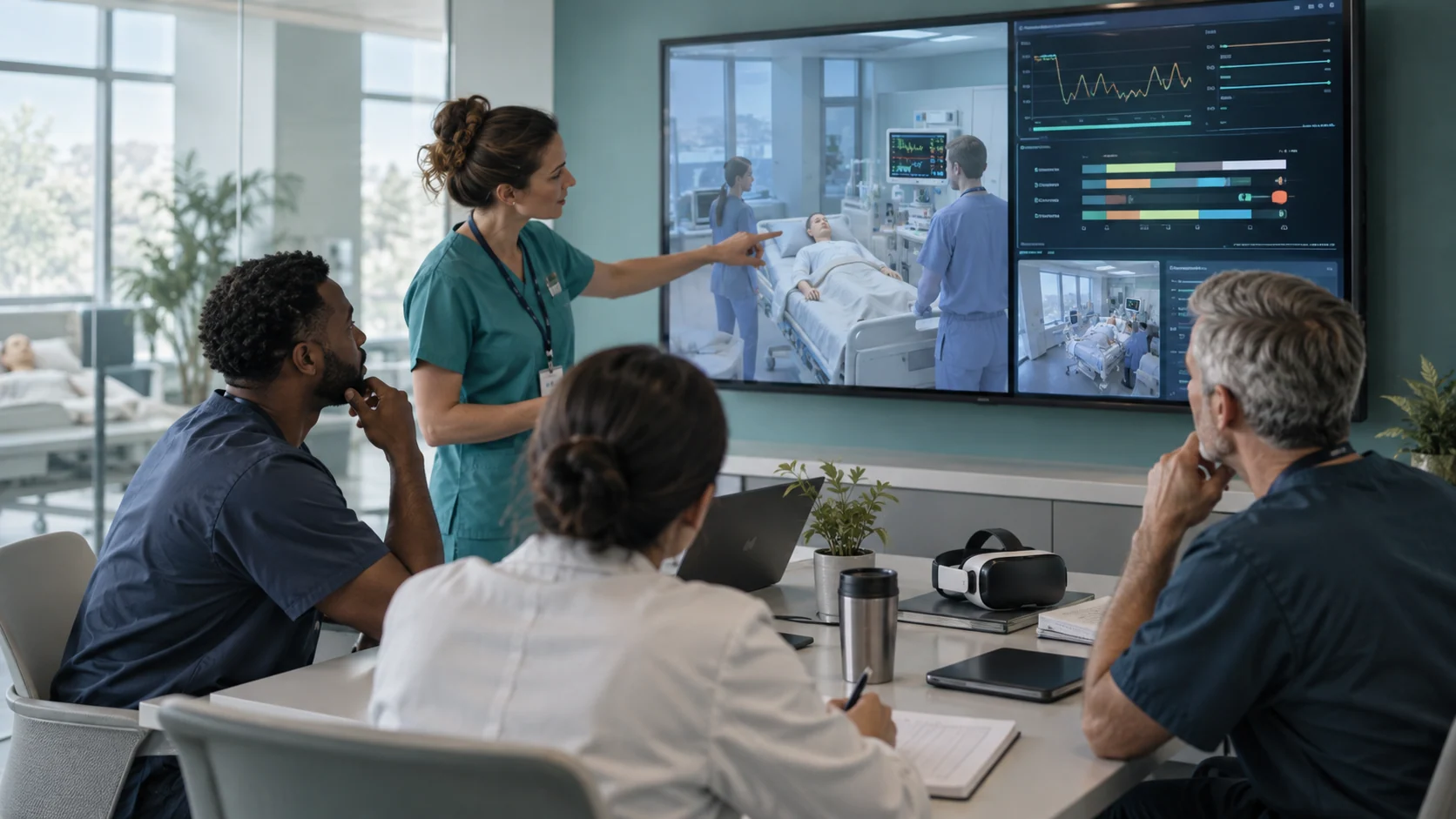
Concept illustration: Simulation Debriefing in Healthcare: A Practical XR Guide

For new staff, combine debrief planning with XR clinical onboarding and competency validation.


3. Use a Clear Debriefing Structure


A consistent structure helps facilitators manage time while allowing participants to think. A practical sequence has three broad phases: reactions, analysis, and summary. The reactions phase checks emotions and first impressions. Analysis explores decisions and consequences. Summary identifies lessons, strengths, and changes that should transfer to practice.

Begin with open prompts such as “How did that feel?” and “What stood out?” Keep this phase brief but genuine. If a participant is distressed or defensive, moving immediately into detailed critique may close the conversation. Listen for different mental models: team members may have acted from conflicting interpretations of the patient's condition.

During analysis, move from observable facts to reasoning. Describe what was seen or heard without judgment, share your concern or curiosity, and ask what the participant was thinking. This approach makes it possible to discuss a missed escalation, unclear instruction, or delayed intervention while respecting the learner's perspective.

End with a small number of takeaways. Ask participants to state what they will preserve, what they will change, and what support they need. Link each point to a clinical standard, local procedure, or team behaviour. A debrief is complete when learning has a destination beyond the simulation room.

The guidance on measuring medical simulation training helps connect discussion with observable competency evidence.


4. Use XR Data and Playback Without Losing Context


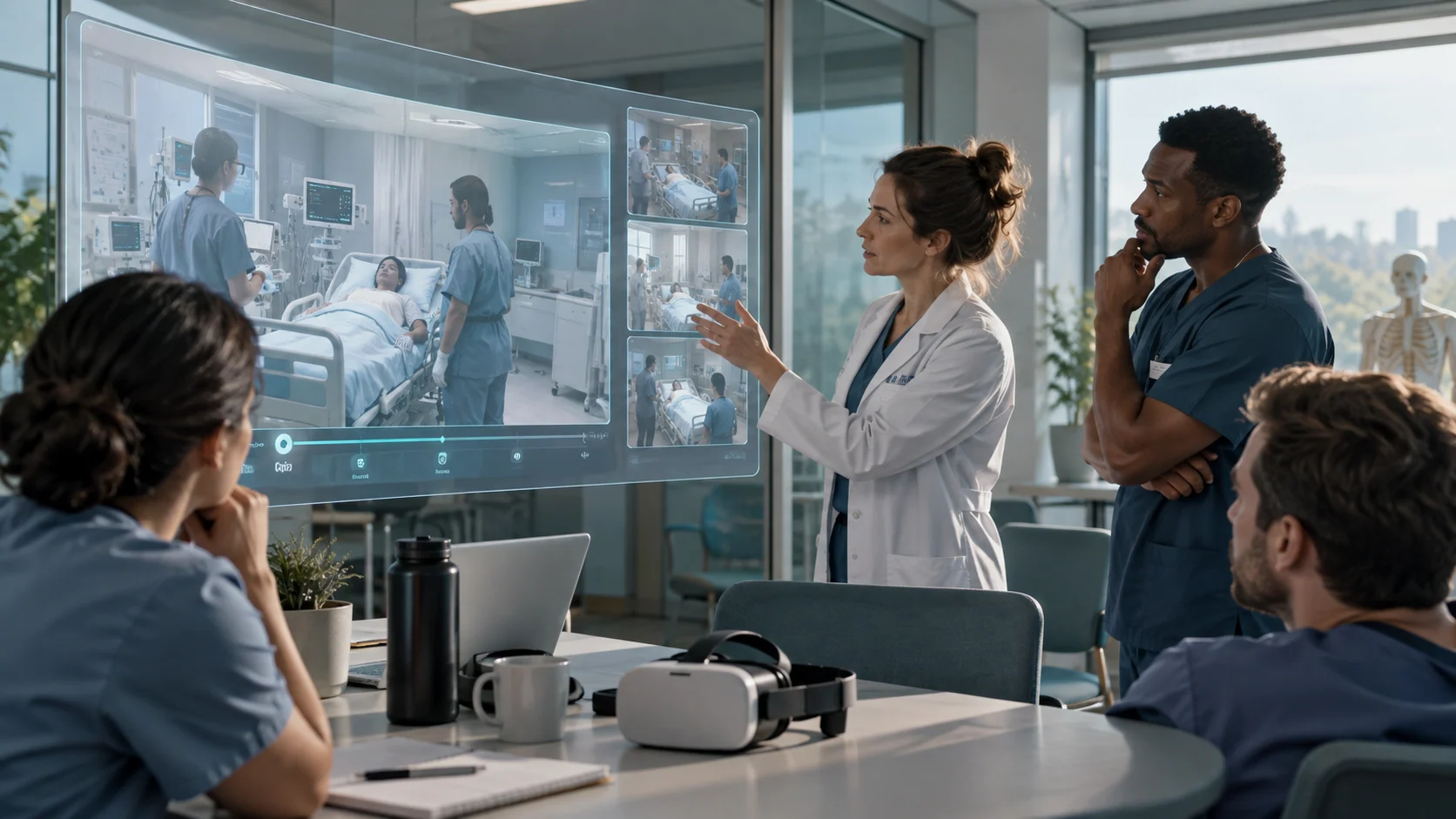
XR platforms can provide timestamps, gaze or movement data, interaction logs, branching choices, communication events, and video playback. These records can improve recall and reveal patterns that participants could not observe while managing the scenario. Data should support inquiry rather than become a scoreboard that oversimplifies clinical judgment.

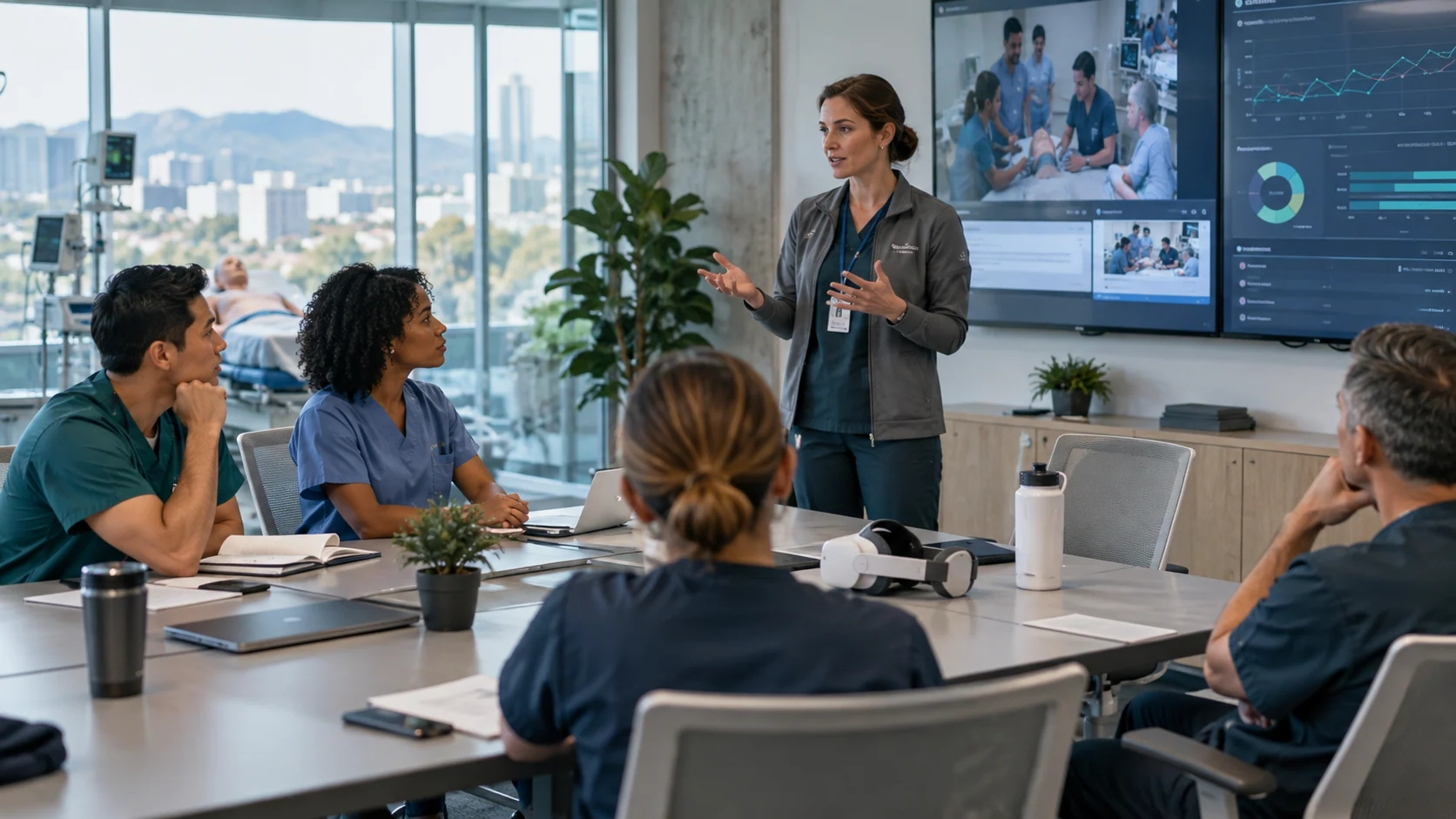
Concept illustration: Simulation Debriefing in Healthcare: A Practical XR Guide

Select short clips or events tied to the objectives. Replaying the entire scenario consumes time and can encourage passive watching. Pause immediately before a decision point and ask participants what information they noticed, what they expected, and which options they considered. Then compare that account with the available evidence.

Metrics require interpretation. Faster completion is not always safer; more speech does not mean clearer communication; and a correct final decision can follow a fragile process. Combine platform data with facilitator observation, participant reasoning, clinical standards, and the constraints built into the scenario.

Protect privacy and maintain transparent governance. Define who can view recordings, how long they are retained, whether they are used for assessment or research, and how learners can raise concerns. Remove patient information from scenarios unless there is a lawful, necessary, and approved reason to include it.

For analytics design, read about predictive analytics in healthcare XR and responsible data workflows.

Clinical teams can also compare debrief data with clinical digital twins used for planning and patient-flow modelling.


5. Facilitate Difficult Conversations and Team Learning


Difficult moments are normal. A participant may feel embarrassed, blame the technology, challenge the scenario, or disagree with a colleague. Facilitators should slow the discussion, restate shared goals, and explore each perspective. Valid technical limitations can be acknowledged without abandoning examination of the team's response.

Keep feedback specific and behavioural. Replace labels such as “poor communication” with an observation: the medication request did not include a dose, the receiver did not repeat it back, and the team later held different assumptions. Specific language creates a path for practice and avoids turning a performance issue into a judgment about character.

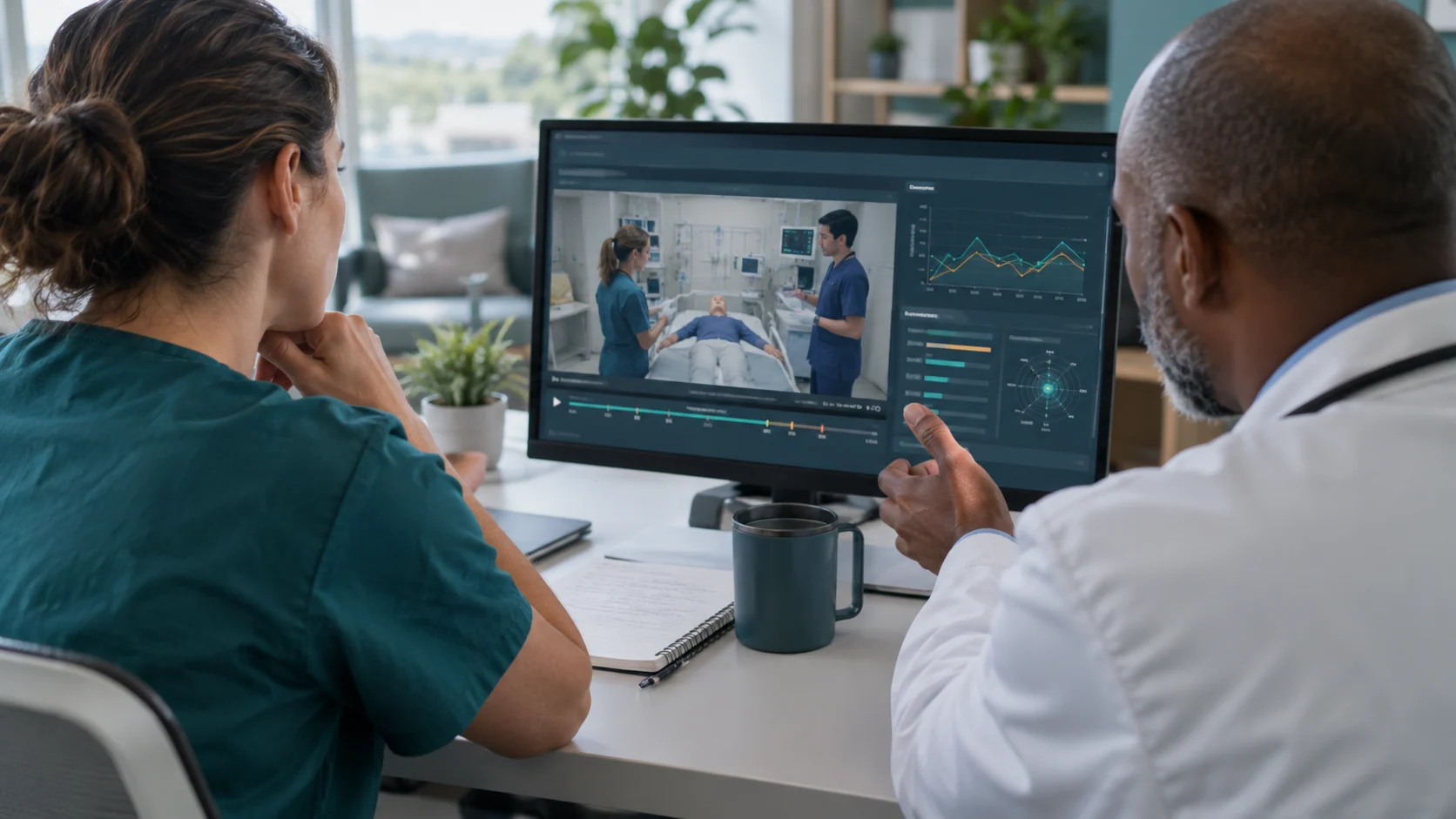
Concept illustration: Simulation Debriefing in Healthcare: A Practical XR Guide

Invite quieter voices and manage hierarchy. Ask each role what information they held and what made it easy or difficult to speak. Senior clinicians can model openness by discussing their own uncertainty. If the debrief includes multiple professions, highlight how systems and role expectations shaped the interaction.

Some issues require action beyond education. Equipment failures, unsafe policies, recurring workload problems, or serious safeguarding concerns should move into the appropriate governance process. Tell participants how findings will be escalated and avoid promising confidentiality that legal or safety duties cannot support.

The de-escalation techniques VR guide offers useful methods for communication under pressure.

For high-stakes teamwork, review XR emergency preparedness training across triage, command, and handoffs.


6. Measure Transfer and Improve the Debriefing Program


Participant satisfaction is useful but insufficient. Measure whether learners can explain key decisions, demonstrate behaviours in a new scenario, retain skills, and transfer them to supervised clinical practice. Where possible, track process indicators such as escalation quality, checklist use, handoff completeness, or response time without claiming that simulation alone caused patient outcomes.

Review facilitator performance as well. Observe whether questions are balanced, objectives are covered, evidence is used fairly, hierarchy is managed, and summary actions are clear. Peer observation, facilitator calibration, and shared examples can reduce inconsistency between sessions.

Create a closed loop for scenario improvement. If participants repeatedly misunderstand a cue, determine whether the issue is a meaningful learning challenge or a design defect. Update instructions, technology, branching logic, data capture, and debrief prompts, then document the change so results remain comparable.

Scale only when capacity supports quality. More headsets and scenarios do not automatically create more learning. Protect facilitator preparation time, technical support, data governance, and opportunities for repeated practice. A strong program treats debriefing as a core intervention rather than an optional conversation after the exciting technology.

Concept illustration: Simulation Debriefing in Healthcare: A Practical XR Guide

Hospitals evaluating investment can compare program design with the VR healthcare training cost guide.

For clinical skill practice, the guide to VR training for nurses shows how scenarios, avatars, and analytics fit together.


Frequently Asked Questions

What is simulation debriefing in healthcare?

It is a structured reflective conversation after a simulated clinical event. Participants examine actions, reasoning, teamwork, evidence, and outcomes, then identify lessons that should transfer to practice.

How long should a healthcare simulation debrief take?

Length depends on complexity and objectives. Many teams reserve at least as much time for debriefing as for the scenario. Focus, psychological safety, and useful reflection matter more than a fixed duration.

What are the main phases of a debrief?

A practical structure includes reactions, analysis, and summary. Participants first reset and share impressions, then examine decisions and evidence, and finally identify key learning and next actions.

Should simulation video always be used?

No. Use short, relevant clips only when they improve recall or analysis. Full playback can consume time and make learners passive. Consent, access, retention, and purpose must be clear.

How do facilitators create psychological safety?

Explain confidentiality and purpose, acknowledge technology limits, use respectful behavioural observations, invite different perspectives, manage hierarchy, and separate formative learning from formal discipline.

Can XR analytics assess clinical competence?

Analytics can provide useful evidence about timing, actions, choices, and interaction patterns. They should be interpreted with observation, reasoning, standards, and context rather than treated as complete proof of competence.

What should happen after a serious safety issue is identified?

Move the issue into the appropriate clinical governance, equipment, safeguarding, or incident process. Participants should know how findings will be escalated and what confidentiality limits apply.

Concept illustration: Simulation Debriefing in Healthcare: A Practical XR Guide

How is debriefing different from feedback?

Feedback often provides information about performance. Debriefing is a guided conversation in which participants reconstruct events, explain thinking, compare perspectives, and generate learning together.

How can hospitals improve debriefing quality?

Train facilitators, use shared structures, observe sessions, calibrate standards, review participant outcomes, update scenarios from evidence, and protect enough time for preparation and reflection.


Conclusion

Simulation debriefing is where immersive experience becomes deliberate learning. A clear purpose, safe environment, structured inquiry, careful use of evidence, skilled facilitation, and measurable follow-up help healthcare teams turn practice into better performance.

Explore Mimic Health XR to discuss realistic healthcare simulations, AI avatars, and XR training workflows for your clinical team.

Back to insights